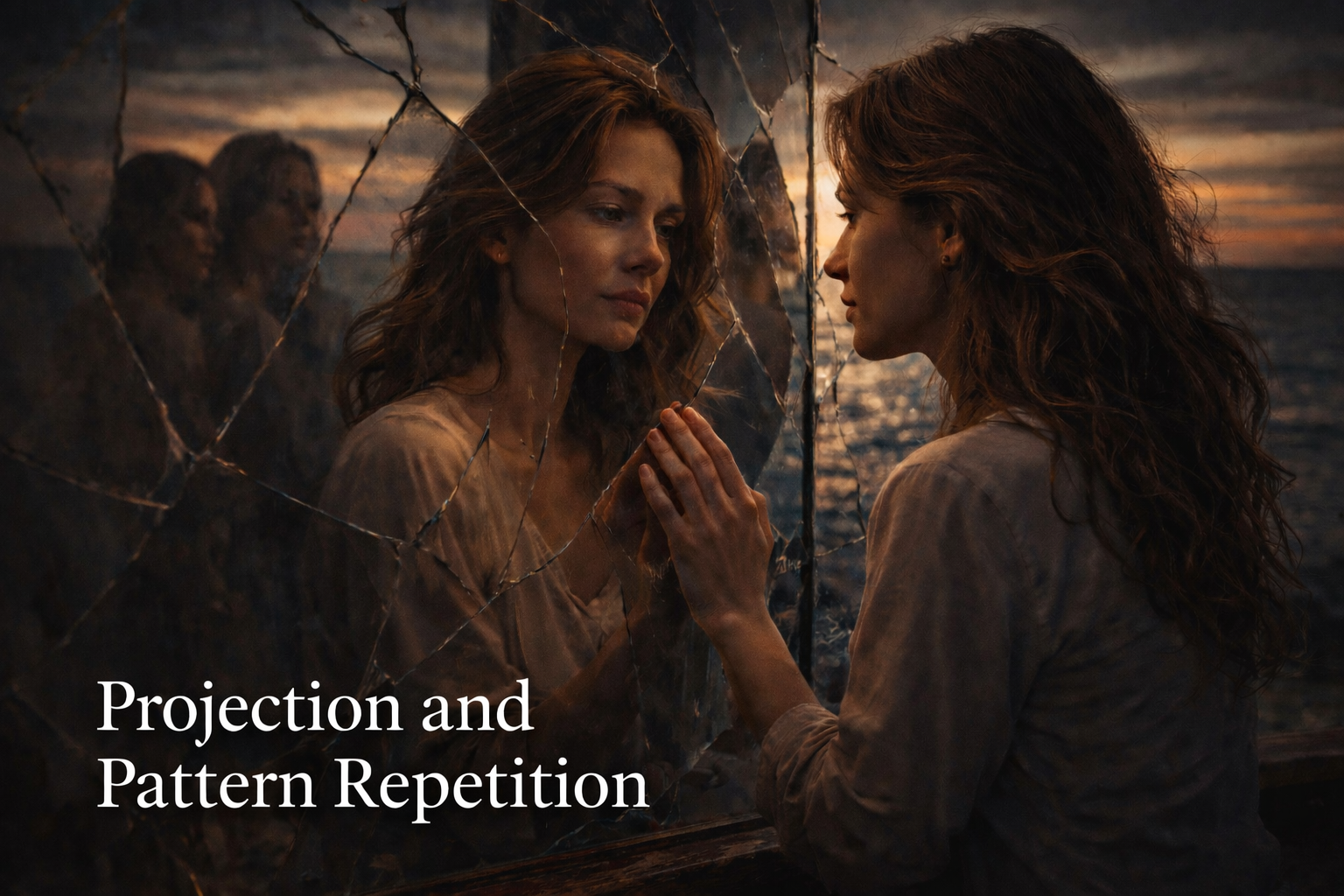
Most people believe they are responding to the person in front of them.
Often they are responding to someone from their past.
Projection is one of the quiet forces shaping modern connection.
It happens before trust forms.
Before stability develops.
Sometimes before the relationship has even begun.
A new partner appears.
But the emotional template is already written.
The Mind Does Not Start Fresh
Human perception is not neutral.
The brain organizes experience through memory.
Past relationships create emotional maps that influence how new connections are interpreted.
Someone who has been betrayed may scan for signs of dishonesty.
Someone who has felt abandoned may search constantly for reassurance.
Someone who has been criticized may expect judgment even when none is present.
The new partner enters the relationship carrying their own history.
But they are also stepping into a space already shaped by someone else.
Projection fills that space quickly.
Sometimes without either person noticing.
Familiarity Feels Like Truth
People often describe certain connections as “familiar.”
They believe familiarity means compatibility.
Often it means something else.
It means the emotional structure resembles something the mind has already experienced.
That resemblance can feel comforting.
Or it can feel intense.
But intensity does not necessarily indicate health.
It often indicates recognition.
The nervous system recognizes a pattern.
And recognition pulls people deeper into the dynamic.
Even when that dynamic failed before.
The Return to the Same Path
This is how patterns repeat across relationships.
A person leaves a relationship believing the problem was the individual partner.
The next connection appears different.
Different personality.
Different background.
Different circumstances.
Yet the emotional dynamic begins unfolding in familiar ways.
The same arguments appear.
The same misunderstandings emerge.
The same instability returns.
The people have changed.
The pattern has not.
When Projection Distorts Reality
Projection becomes powerful when perception begins replacing observation.
Instead of responding to what a partner actually does, the mind begins reacting to what it expects.
A delayed text becomes evidence of disinterest.
A disagreement becomes evidence of incompatibility.
A moment of distance becomes proof of abandonment.
These reactions are not always irrational.
They are often echoes.
Echoes of previous relationships where those signals meant something real.
But the new partner may not be repeating the same behavior.
The pattern exists in perception before it exists in reality.
Pattern Repetition Inside Affairs
Projection and pattern repetition can also appear inside infidelity.
People often assume affairs are driven purely by desire.
Sometimes they are driven by recognition.
Someone who feels unseen in a marriage may become drawn to a person who offers immediate affirmation.
Someone who feels unappreciated may gravitate toward someone who notices them.
Someone who feels emotionally ignored may respond quickly to someone who listens.
What appears to be passion can sometimes be emotional relief.
But relief is not the same as transformation.
In many cases, the person pursuing the affair does not actually intend to abandon their existing relationship.
They may still want their marriage to work.
They may still care deeply about their spouse.
They may still see their life continuing within that structure.
The new connection becomes something else.
A source of validation.
A place where they feel seen again.
A place where their identity is briefly restored.
In this situation the outside relationship can function as a kind of emotional safety net.
It confirms that they are still attractive.
Still desired.
Still important to someone.
The person they pursue becomes the mirror that reflects those feelings back to them.
In some cases the person pursuing the outside connection may even express something revealing without fully recognizing what they are saying.
They may say they like who they are when they are with the other person.
What they are often describing is not simply attraction.
It is identity relief.
With the new person they feel admired.
Understood.
Desired.
They feel like the version of themselves they believe they once were.
Or the version of themselves they believe they should be.
That feeling can become powerful.
Not because the connection is necessarily deeper.
But because the emotional reflection is different.
At the same time, they may still want their marriage to survive.
The existing relationship represents stability.
History.
Structure.
A life already built.
The outside connection becomes something else entirely.
Validation without responsibility.
Affection without consequence.
A place where they can feel wanted again without dismantling the life they already have.
This is where another dynamic often appears.
Selective honesty.
They may tell parts of the truth.
They may admit they are unhappy.
They may acknowledge the connection exists.
But they omit the parts that would expose the full reality.
In their mind this feels different from lying.
If no direct false statement was spoken, they believe they have remained honest.
But omission still protects the pattern.
And the pattern continues operating quietly beneath the surface.
But because the underlying pattern has not changed, the dynamic often begins repeating itself there as well.
The same emotional needs appear.
The same tensions emerge.
The same instability develops.
What seemed like an escape from one relationship begins recreating the same structure inside another.
The partner changes.
The emotional conditioning does not.
And without recognizing that conditioning, the individual can move from one connection to another believing they are making a different choice each time.
When in reality they are following a familiar path their nervous system already understands.
Early Imprinting and Family Patterns
Projection and pattern repetition do not begin with adult relationships.
They often begin much earlier.
Long before someone learns how to date, they are learning how people treat each other inside the home they grow up in.
Children observe everything.
How parents speak to each other.
How conflict is handled.
Who withdraws.
Who pursues.
Who apologizes.
Who avoids responsibility.
They observe how affection appears and how it disappears.
They observe how criticism is delivered.
They observe which emotions are safe and which emotions are ignored.
Even when nothing is explained directly, the nervous system is learning.
It learns what closeness looks like.
It learns what distance looks like.
It learns what tension feels like.
And over time those observations become internal templates.
Psychologists sometimes call these relational maps.
They quietly shape what feels normal later in life.
Someone raised in a household where affection was inconsistent may unconsciously gravitate toward inconsistent partners.
Someone raised around criticism may feel strangely familiar with partners who judge them.
Someone raised around emotional distance may interpret detachment as independence.
None of this is deliberate.
It is pattern recognition.
The nervous system recognizes dynamics it has experienced before and interprets them as familiar.
And familiarity often feels like chemistry.
What people describe as “a strong connection” can sometimes be recognition of a pattern learned much earlier.
Not because the pattern is healthy.
But because it is known.
When those early patterns remain unexamined, people can spend years recreating emotional environments that feel strangely familiar.
The partners change.
The pattern remains.
And without awareness, the individual believes they are making new choices each time.
When in reality, they are responding to emotional templates that were formed long before the first adult relationship ever began.
Why Familiar Pain Feels Safer
One of the most confusing aspects of projection is how strongly people are drawn toward familiar emotional structures.
Even when those structures caused pain before.
The human nervous system values predictability.
Familiar experiences, even difficult ones, are easier to navigate than unfamiliar emotional territory.
A person may intellectually want something healthier.
But their emotional system recognizes and responds to what it already understands.
Familiar criticism.
Familiar distance.
Familiar tension.
These dynamics may not feel pleasant.
But they feel recognizable.
And recognition can quietly guide choices without conscious awareness.
This is why people sometimes leave one unstable relationship only to find themselves inside another with similar dynamics.
The individuals may be different.
The emotional pattern is not.
The Illusion of Choosing Differently
Pattern repetition often surprises people.
They believe they are choosing something new.
In reality they are recognizing something old.
Recognition happens faster than reflection.
Faster than logic.
Faster than caution.
The brain moves toward what it understands.
Even when what it understands has created instability before.
Someone may believe they are choosing a different partner.
But they may still be choosing the same emotional structure.
The same rhythm of validation and tension.
The same push and pull.
The same search for recognition.
Without awareness, familiarity quietly shapes attraction.
Breaking the Pattern
Pattern repetition stops only when someone begins recognizing the projection itself.
When they pause long enough to ask different questions.
Am I responding to this person or to someone from my past?
Is this reaction based on present behavior or past experience?
Is this connection developing naturally or following a familiar script?
These questions slow the automatic process.
They create space between perception and projection.
And inside that space, something new can begin.
Modern Connection and the Patterns We Carry
Modern connection is not simply about meeting someone new.
It is about what each person brings into the interaction.
History.
Expectation.
Fear.
Conditioning.
Unresolved emotional maps.
When two people meet, their histories meet with them.
Sometimes those histories create stability.
Sometimes they recreate the same cycles that ended previous relationships.
The difference lies in awareness.
Because without awareness, projection quietly shapes perception.
And perception quietly repeats the past.
Even when someone believes they have finally chosen a different path.
Continue Reading in The Damaged and the Broken:
- Article VI: Emotional Regulation
- Article IV: The Pursuer–Distancer Cycle
- Article III: The Technically Single Problem
- Article II: Emotional Starvation and the Validation Trap
- Article I: Modern Connection and the Weight We Carry
- The Damaged and the Broken (Overview)

Websites, hosting, email & digital tools for growing brands.