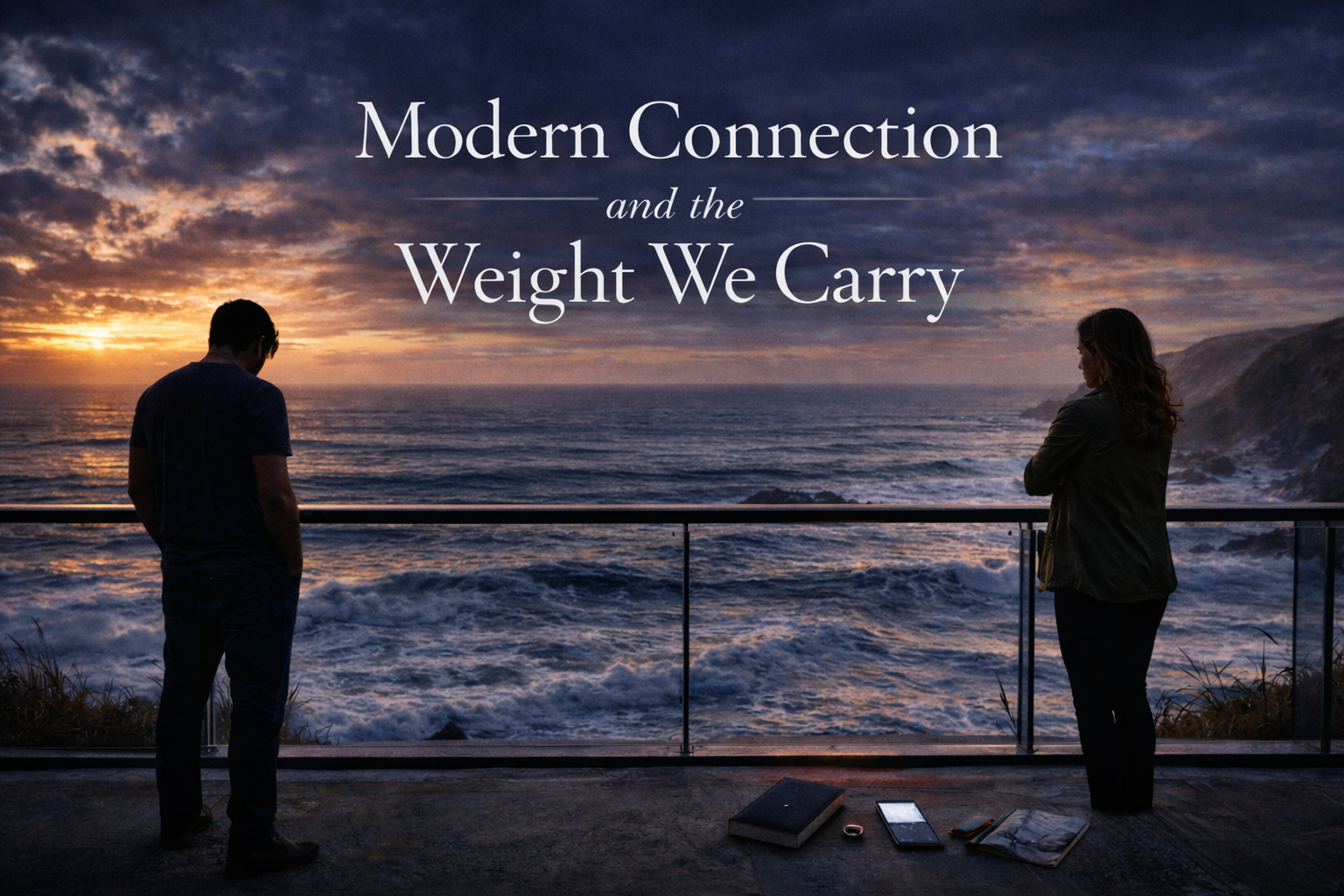
Spend enough time observing modern relationships and a pattern becomes impossible to ignore.
People are not entering connection hopeful.
They are entering calibrated.
They ask better questions.
They listen for inconsistencies.
They move slower.
They trust less quickly.
Not because they are cold.
Because they have lived.
Modern connection is not built on innocence anymore. It is built on aftermath.
Divorce.
Betrayal.
Custody disputes.
Financial fallout.
Engagements that ended abruptly.
Years invested where there was no return.
No one walks in untouched.
The Aftermath Generation
Talk to someone who went through divorce and you’ll hear about erosion.
Not always explosive endings.
Slow fractures.
Communication decay.
Resentment that hardened.
Parallel lives under one roof.
Divorce recalibrates tolerance.
Now talk to someone who was cheated on.
You’ll hear something else.
Hyper-awareness.
Pattern scanning.
Sensitivity to tone shifts.
A nervous system that reacts quickly to silence.
That isn’t paranoia.
It’s adaptation.
The modern dating pool is filled with people who adapted to survive something.
And adaptation doesn’t switch off when something new begins.
The Affair That Wasn’t About Sex
Not every betrayal begins with thrill-seeking.
Some begin with erosion.
Years of not being seen.
Not being affirmed.
Not being desired.
Not being appreciated.
Attraction doesn’t disappear overnight in long relationships, recognition does.
And recognition matters.
When someone feels invisible long enough, they start looking for reflection elsewhere.
An affair, in those cases, isn’t always about conquest.
It’s about validation.
Someone else saying:
“I see you.”
“You still matter.”
“You’re still attractive.”
“You’re still wanted.”
That does not justify betrayal.
But it explains why it happens in relationships that looked stable from the outside.
The person who cheats may not describe themselves as selfish.
They may describe themselves as starved.
The problem is not that they had needs.
The problem is that they addressed them in secrecy.
And secrecy fractures trust in ways neglect never could.
When those individuals re-enter the dating world, they carry a different weight.
Not just the memory of collapse
but the knowledge of what they are capable of when they feel unseen.
Hyper-Independence
After enough instability, people build strength.
They rebuild finances.
They rebuild routines.
They rebuild self-sufficiency.
They learn not to rely too heavily on anyone.
From the outside, it looks powerful.
And it is.
But hyper-independence has a shadow.
It limits vulnerability.
It reduces reliance.
It protects peace aggressively.
Two hyper-independent adults can build something stable.
But stability without softness feels restrained.
Modern relationships often stall not because of chaos but because neither person wants to disrupt the equilibrium they fought hard to create.
Protection becomes posture.
And posture limits depth.
The “Technically Single” Era
There is another force quietly shaping modern connection.
Blurred availability.
Separated but not divorced.
Divorced but still emotionally entangled.
Co-parenting but still in conflict.
Financially linked.
Legally intertwined.
People say they are free.
Sometimes they are.
Sometimes they are still negotiating the past.
When someone discovers that mid-relationship, the damage doesn’t end with that experience.
It hardens the next one.
Trust becomes conditional.
Openness becomes cautious.
Calibration increases.
Digital Fatigue
Add digital dating culture to this landscape.
Infinite profiles.
Endless conversations.
Low-cost exits.
Abundance changes psychology.
When options feel unlimited, investment decreases.
When investment decreases, emotional depth thins.
People become replaceable before they become known.
Serious adults feel it first.
They grow selective.
Selective gets misread as distant.
Distance gets misread as disinterest.
Burnout spreads quietly.
Not from hatred.
From repetition.
When Histories Collide
The real friction doesn’t live in bios or first impressions.
It appears when two nervous systems activate in the same room.
One person learned to pursue reassurance.
The other learned to withdraw under pressure.
One interprets silence as danger.
The other interprets intensity as threat.
Attraction brings them together.
History pulls at them in opposite directions.
Neither intends harm.
Both react to memory.
This is the collision.
Not between good and bad people.
Between coping mechanisms.
The Weight in Motion
The weight people describe in modern dating is not abstract.
It moves.
It shows up in arguments that escalate too fast.
In hesitation that looks like indifference.
In caution that feels like distance.
In guardedness mistaken for lack of interest.
The weight is accumulated experience negotiating vulnerability.
It is memory protecting against repetition.
And it is constant.
Two adults entering connection are not just choosing each other.
They are managing what their past taught them.
If that past is unexamined, it runs the room.
If it is acknowledged, it can be integrated.
The Real Divide
The divide is not age.
It is not damage.
It is accountability.
Everyone carries history.
Not everyone examines it.
Some integrate their patterns.
Others repeat them under new circumstances.
Some confront their role in collapse.
Others rewrite the narrative to preserve ego.
Modern relationships feel heavier because illusion is gone.
People know cheating happens.
They know divorces turn vicious.
They know attraction is not stability.
They know peace is fragile.
That awareness can make them guarded.
Or it can make them deliberate.
The damaged and the broken are not defined by what happened to them.
They are defined by whether they faced it.
That is where modern connection either fractures again
or finally matures.
Article II: Emotional Starvation and the Validation Trap

Websites, hosting, email & digital tools for growing brands.