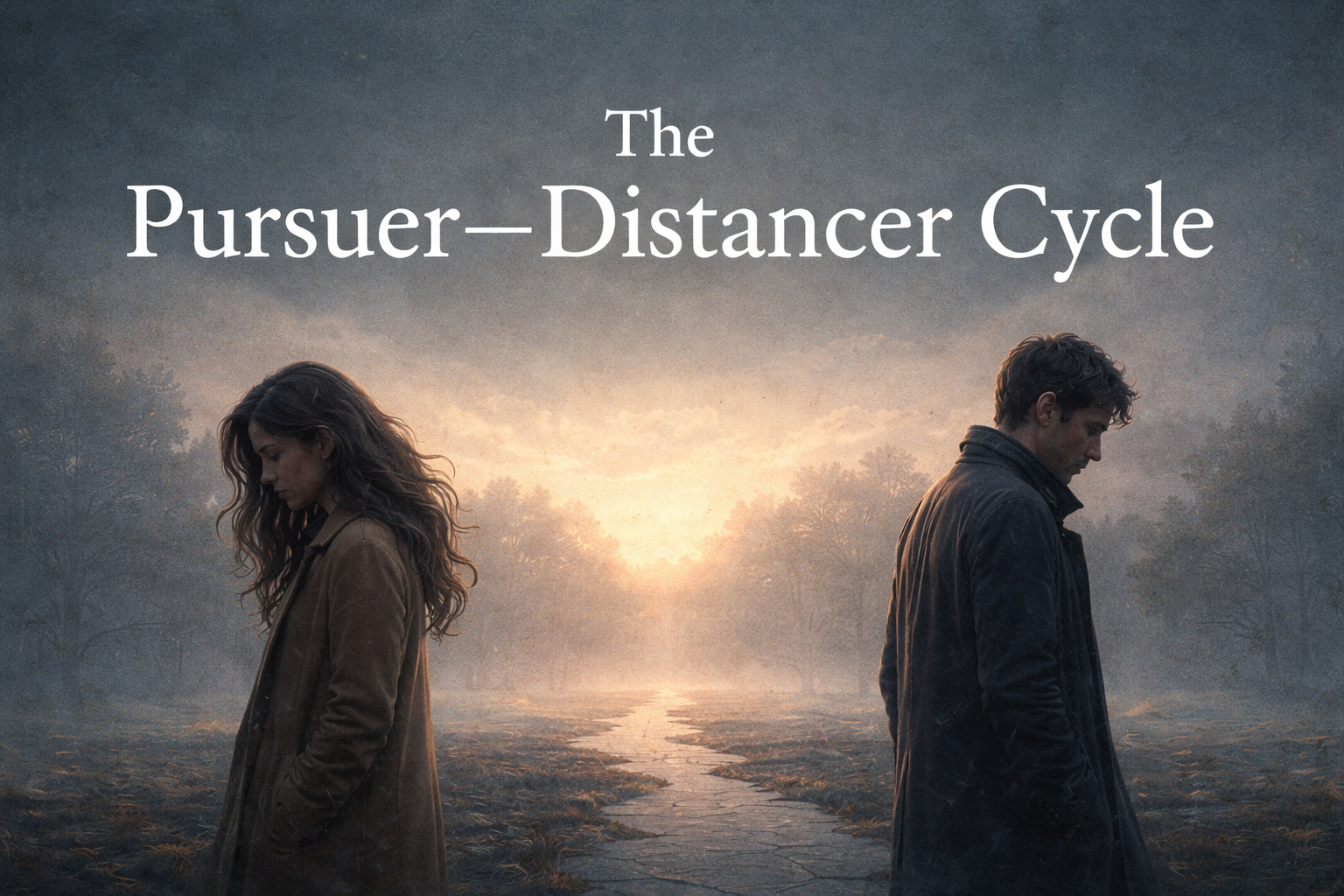
Most connection problems don’t begin with conflict.
They begin with misaligned regulation.
One person moves closer.
The other steps back.
One tries to stabilize the connection through reassurance.
The other stabilizes themselves through distance.
Neither person intends to create tension.
But together they create motion.
And motion becomes pattern.
Psychologists call it the pursuer–distancer cycle.
How the Cycle Begins
The pattern rarely begins dramatically.
There is no argument.
No betrayal.
No obvious rupture.
Instead, uncertainty appears.
One partner becomes slightly more attentive.
The other partner becomes slightly more reserved.
The pursuer reaches for reassurance.
The distancer reaches for space.
At first the difference is small.
But regulation patterns amplify quickly once they interact.
What begins as a small adjustment becomes a rhythm.
And rhythms are difficult to interrupt once they take hold.
When the Pattern Exists From the Start
The pursuer–distancer dynamic does not always develop later in a relationship.
Sometimes it is present from the very beginning.
One person pushes the connection forward.
The other hesitates.
One suggests meeting.
The other slows the pace.
One seeks closeness early.
The other tries to maintain distance.
At first this difference can even feel attractive.
The pursuer experiences the distance as intrigue.
The distancer experiences the pursuit as attention.
What appears to be chemistry can actually be the early formation of a regulatory pattern.
One person establishes momentum.
The other establishes restraint.
Neither person recognizes the dynamic yet.
It simply feels like two different personalities interacting.
But the pattern quietly begins shaping the relationship from the start.
The pursuer becomes the one who moves things forward.
The distancer becomes the one who regulates the pace.
And once those roles take hold, they rarely stay temporary.
They become the structure of the relationship itself.
When the Pursuer Is Already in a Relationship
Another place this pattern often appears is when someone who is already in a committed relationship begins pursuing a new connection.
The imbalance is immediate.
One person is pushing the connection forward.
The other recognizes the risk and tries to slow it down.
The pursuer frames the interaction as emotional closeness.
The other person frames it as restraint.
At first the dynamic appears simple.
One person insists the connection matters.
The other insists the situation is complicated.
But the same regulatory pattern forms.
The pursuer increases pressure.
The distancer attempts to maintain boundaries.
Over time those boundaries weaken.
Closeness grows.
Often outside the awareness of the existing partner.
The spouse or partner at home may be intelligent, perceptive, and deeply invested in the relationship yet still unaware that emotional momentum has begun elsewhere.
Not because they lack insight.
But because emotional shifts rarely announce themselves clearly.
They begin quietly, inside ordinary conversations, small moments of attention, and the gradual redirection of emotional energy.
By the time the pattern becomes visible, the pursuer–distancer dynamic is already in motion.
And once an emotional bond forms, the cycle can reverse.
The person who once pursued may begin pulling back.
The person who once hesitated may begin seeking stability.
The roles change.
But the pattern remains.
What began as hesitation becomes a pursuer–distancer cycle.
Regulation, Not Rejection
The most important misunderstanding in this dynamic is interpretation.
The pursuer often interprets distance as rejection.
The distancer interprets pursuit as pressure.
Both reactions are emotional regulation strategies.
The pursuer reduces anxiety by moving toward connection.
The distancer reduces anxiety by creating space.
Neither strategy is malicious.
Neither partner wakes up intending to destabilize the relationship.
But together they create escalation.
Because reassurance for one person feels like intrusion to the other.
And distance for one person feels like abandonment to the other.
Acceleration Without Awareness
Once the cycle begins, each reaction fuels the other.
Distance increases pursuit.
Pursuit increases distance.
Messages become longer.
Replies become shorter.
One person tries harder.
The other person slows further.
Small signals become large interpretations.
A delayed response becomes emotional evidence.
A brief reply becomes perceived disinterest.
What began as a subtle difference in regulation turns into a feedback loop.
And the loop continues even when both people are trying to preserve the relationship.
Labels That Miss the Pattern
Over time the cycle begins to shape identity.
The pursuer becomes labeled “needy.”
The distancer becomes labeled “cold.”
Neither description is accurate.
The pursuer is attempting to stabilize uncertainty through closeness.
The distancer is attempting to stabilize uncertainty through autonomy.
Both are trying to regulate discomfort.
But labels simplify a dynamic that is actually systemic.
The problem is not personality.
The problem is interaction.
Two strategies that work individually begin to destabilize each other when they collide.
The Digital Amplifier
Modern connection intensifies this cycle.
Digital communication creates constant visibility.
Message timing becomes interpretation.
Response speed becomes emotional data.
A delayed reply becomes meaning.
An online status becomes evidence.
A read receipt becomes a psychological trigger.
What once required days to notice can now be detected in minutes.
This amplifies anxiety for the pursuer.
And increases pressure for the distancer.
The cycle accelerates faster than it did in previous generations.
Because digital visibility turns ordinary pauses into perceived signals.
And perceived signals often drive emotional reaction.
Attachment Patterns Beneath the Surface
Most pursuer–distancer dynamics are not created in the current relationship.
They are activated by it.
Attachment patterns form long before two adults meet.
Someone who learned that attention must be pursued continues pursuing.
Someone who learned that independence protects stability continues distancing.
These patterns feel natural to the people carrying them.
Which is why they rarely appear dysfunctional from the inside.
The relationship does not create the pattern.
It simply exposes it.
And once exposed, both partners begin reacting to each other’s regulation style.
When the Cycle Becomes Exhaustion
Eventually the pattern drains both people.
The pursuer feels chronically uncertain.
The distancer feels chronically pressured.
Both begin to protect themselves.
The pursuer may escalate emotionally in an attempt to break through the distance.
The distancer may withdraw further in an attempt to restore calm.
Conversations shorten.
Emotional investment declines.
The relationship begins to feel unstable even when both people care.
What collapses is not feeling.
What collapses is regulation.
The cycle has replaced connection.
When the Pattern Becomes Identity
Over time the pursuer–distancer dynamic can become more than a temporary interaction.
It becomes expectation.
The pursuer begins anticipating distance before it appears.
The distancer begins anticipating pressure before it arrives.
Each partner starts responding not only to the other person’s behavior, but to the pattern itself.
This is when the relationship begins to feel scripted.
The pursuer may begin conversations already prepared to defend the connection.
The distancer may begin conversations already prepared to protect autonomy.
Both reactions are attempts to manage the pattern.
But reacting to the pattern strengthens it.
Soon the relationship is no longer two people responding to each other.
It is two people responding to the roles they believe they occupy.
Once that shift occurs, the cycle becomes harder to interrupt.
Because breaking the pattern requires both people to tolerate discomfort simultaneously.
The pursuer must tolerate uncertainty.
The distancer must tolerate closeness.
Without that shared adjustment, the cycle simply continues.
Modern Connection and the Pattern
The pursuer–distancer cycle explains why many modern relationships begin with intensity and end with confusion.
The instability is not random.
It emerges when two different regulation strategies collide.
One partner seeks reassurance through closeness.
The other seeks stability through distance.
Without awareness, the pattern quietly organizes the relationship.
Each person begins reacting not to the present moment, but to the behavior they expect from the other.
Over time the connection stops feeling spontaneous.
It starts feeling predictable.
Not predictable because the people lack feeling.
Predictable because the pattern has taken control.
And once a relationship is organized around regulation instead of connection, stability becomes difficult to sustain.
Not because the people involved are incompatible.
But because the dynamic between them was never neutral to begin with.
Continue Reading in The Damaged and the Broken:
- Article V: Projection and Pattern Repetition
- Article III: The Technically Single Problem
- Article II: Emotional Starvation and the Validation Trap
- Article I: Modern Connection and the Weight We Carry
- The Damaged and the Broken (Overview)

Websites, hosting, email & digital tools for growing brands.