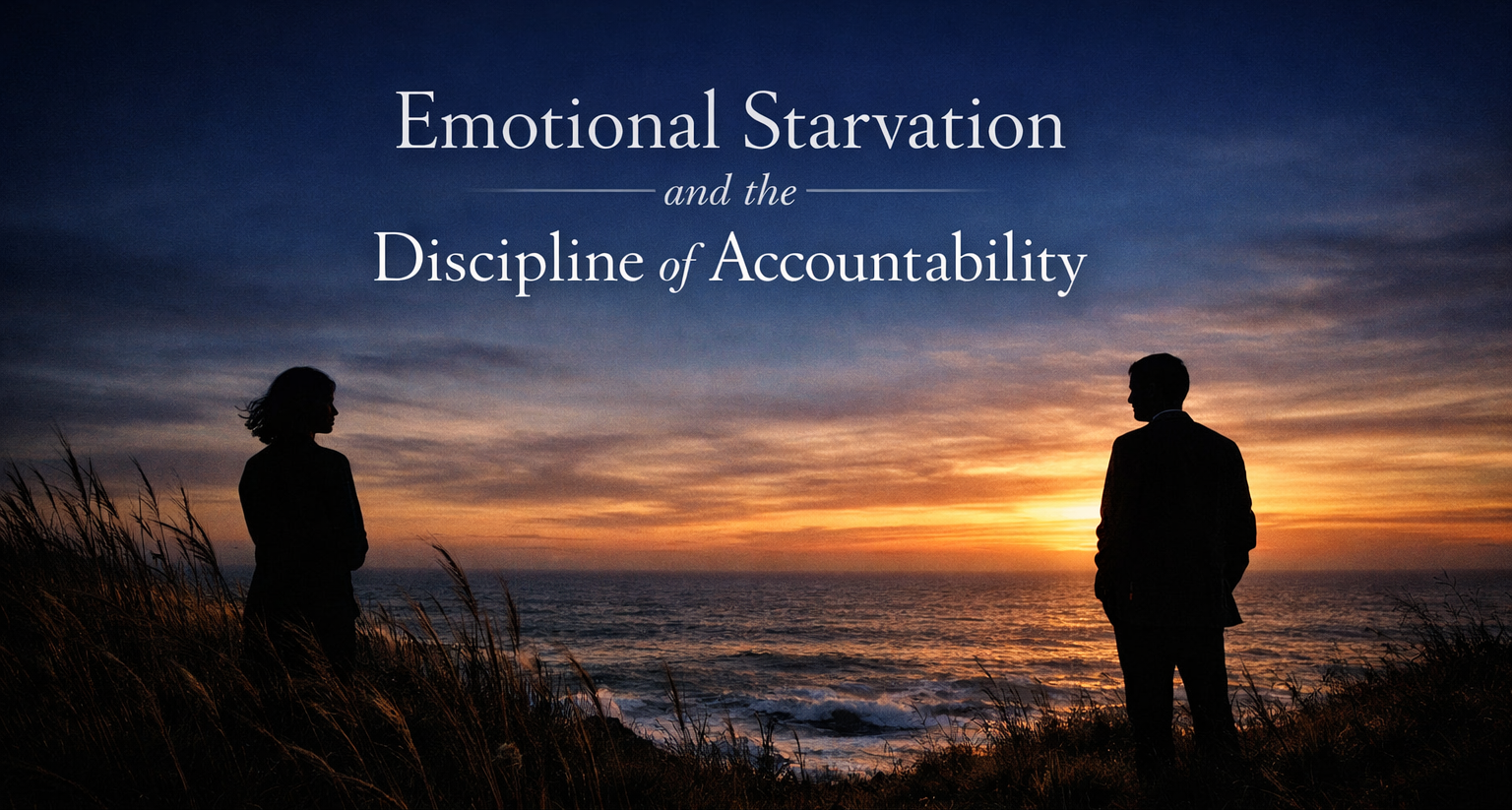
Erosion, Not Explosion
Most affairs don’t begin with lust.
They begin with erosion.
Not explosive arguments.
Not dramatic declarations of unhappiness.
Not even hatred.
Erosion.
Years of not being seen.
Not being affirmed.
Not being desired in the way someone once was.
Not being acknowledged for effort that quietly keeps a life functioning.
Attraction rarely disappears first in long-term connection.
Recognition does.
And recognition is oxygen.
When someone feels invisible long enough, they begin to suffocate quietly. They may not use that word. They may not even consciously register it. But something shifts. Compliments become rare. Touch becomes logistical. Appreciation becomes assumed.
Responsibilities increase as affirmation decreases.
Work expands. Children arrive. Stress compounds. Energy drains. What once felt like partnership begins to feel like administration.
One partner may not notice the change at all.
The other feels it immediately.
It doesn’t feel dramatic.
It feels like disappearing.
And quiet deprivation can destabilize a person more effectively than loud conflict ever could.
The Search for Reflection
At first, no one is looking for an affair.
They are looking for reflection.
Someone who notices.
Someone who listens without distraction.
Someone who says:
“You look good.”
“I appreciate you.”
“I see how hard you’re trying.”
Validation is not weakness. It is reinforcement. Humans stabilize identity through feedback. When that feedback vanishes at home, it becomes easier to accept it elsewhere.
That is where the trap begins.
The Language of Justification
It often sounds harmless in the beginning.
“It’s just conversation.”
“It’s just someone who understands me.”
“It’s not physical.”
“It’s complicated.”
Relief replaces restraint.
Secrecy replaces transparency.
And the brain reframes the situation as connection instead of betrayal.
But secrecy rarely feels like deception to the person inside it.
It feels manageable.
Because they aren’t lying outright.
They’re telling the truth.
Just not the whole truth.
They will admit they’re talking to someone.
But not how often.
They will admit they’re unhappy.
But not how far they’ve already drifted.
They will admit there’s tension at home.
But not that they’re emotionally invested elsewhere.
Selective honesty becomes moral camouflage.
If nothing technically false is said, they convince themselves nothing truly dishonest is happening.
But omission is still secrecy.
And secrecy is still insulation.
And insulation fractures trust long before physical boundaries are crossed.
Under-Appreciation and Vulnerability
There is an uncomfortable truth here.
Some people cheat because they felt under-appreciated.
Not abused.
Not oppressed.
Not controlled.
Under-recognized.
That does not justify betrayal.
But it explains why it happens inside connections that appeared stable from the outside.
Needs ignored become vulnerabilities.
Vulnerabilities ignored become openings.
And openings invite attention.
The problem is not that someone had needs.
The problem is that they addressed those needs in secrecy instead of confrontation.
Performance and Compartmentalization
And often, while that secrecy unfolds, something else happens.
They perform normalcy.
Photos are posted.
Anniversaries are celebrated publicly.
Family dinners are documented.
Vacation pictures display smiles.
Social media becomes theater.
A curated image of stability is maintained while private reality fractures beneath it.
This duplicity is not always dramatic deception.
Sometimes it is quiet compartmentalization.
Home life stays in one box.
The affair stays in another.
Public identity floats above both.
When someone learns to manage partial truths across compartments, integrity shifts.
They are not “lying,” they tell themselves.
They are protecting complexity.
But complexity without transparency is still distortion.
And distortion reshapes character.
The Other Participant
Affairs are never one-sided.
There is always another person.
And the single person involved carries something too.
Sometimes it is loneliness that has hardened into urgency.
Sometimes it is a pattern of choosing unavailable partners because full availability feels exposing.
Sometimes it is the unconscious belief that partial attention is better than none.
But sometimes it is something colder.
Conquest.
For some single participants, the attraction is not the person.
It is the power dynamic.
To be chosen over a spouse.
To disrupt an existing connection.
To be the secret center of attention.
That feeds something deeper than affection.
It feeds ego.
“If they’ll risk their marriage for me, I must matter.”
The relationship becomes proof of desirability.
Proof of superiority.
Proof of influence.
In these cases, the affair is not about emotional starvation.
It is about validation through dominance.
Narcissistic Supply
Narcissistic traits can drive either side of this equation.
The married partner may crave admiration and novelty.
The single partner may crave exclusivity and control.
Both derive identity from being desired.
Not loved.
Desired.
Desire feeds ego.
Love requires accountability.
When entitlement, lack of empathy, grandiosity, and chronic need for admiration drive the dynamic, the affair becomes less about connection and more about self-enhancement.
The secrecy itself becomes fuel.
Risk amplifies validation.
Validation becomes addictive.
Extraction Over Stability
The deeper question is not moral.
It is psychological.
Why did partial availability feel acceptable?
Why did secrecy increase attraction rather than disqualify it?
Why was being chosen in the shadows enough?
Whether driven by loneliness, under-anchored attachment, emotional starvation, or ego conquest, the pattern is the same.
It is not about building something stable.
It is about extracting something immediate.
And extraction always collapses.
When the affair ends, and most do, both people re-enter connection altered.
The married partner carries guilt or defensiveness.
The single partner carries disillusionment or diminished self-trust.
Trust recalibrates downward.
Caution increases.
The next connection inherits the damage.
This is how instability multiplies quietly.
Article 1: Modern Connection and the Weight We Carry
The Accumulation Effect
In a culture of constant digital access; private messages, reconnecting with old flames, validation one notification away, temptation is never scarce.
What is scarce is restraint.
What is scarce is confrontation.
What is scarce is the willingness to say:
“I feel unseen here, and I am willing to risk conflict to address it.”
Emotional starvation is real.
So is ego.
So is selective truth.
And so is choice.
The real fracture in modern connection is not desire.
It is self-justified secrecy.
And secrecy, no matter how carefully edited, is still deception.
Continue Reading in The Damaged and the Broken:
- Article IV: Divorce Fallout and Identity Reconstruction (3/11/2026)
- Article III:The Technically Single Problem
- Article I: Modern Connection and the Weight We Carry
- The Damaged and the Broken (Overview)

Websites, hosting, email & digital tools for growing brands.