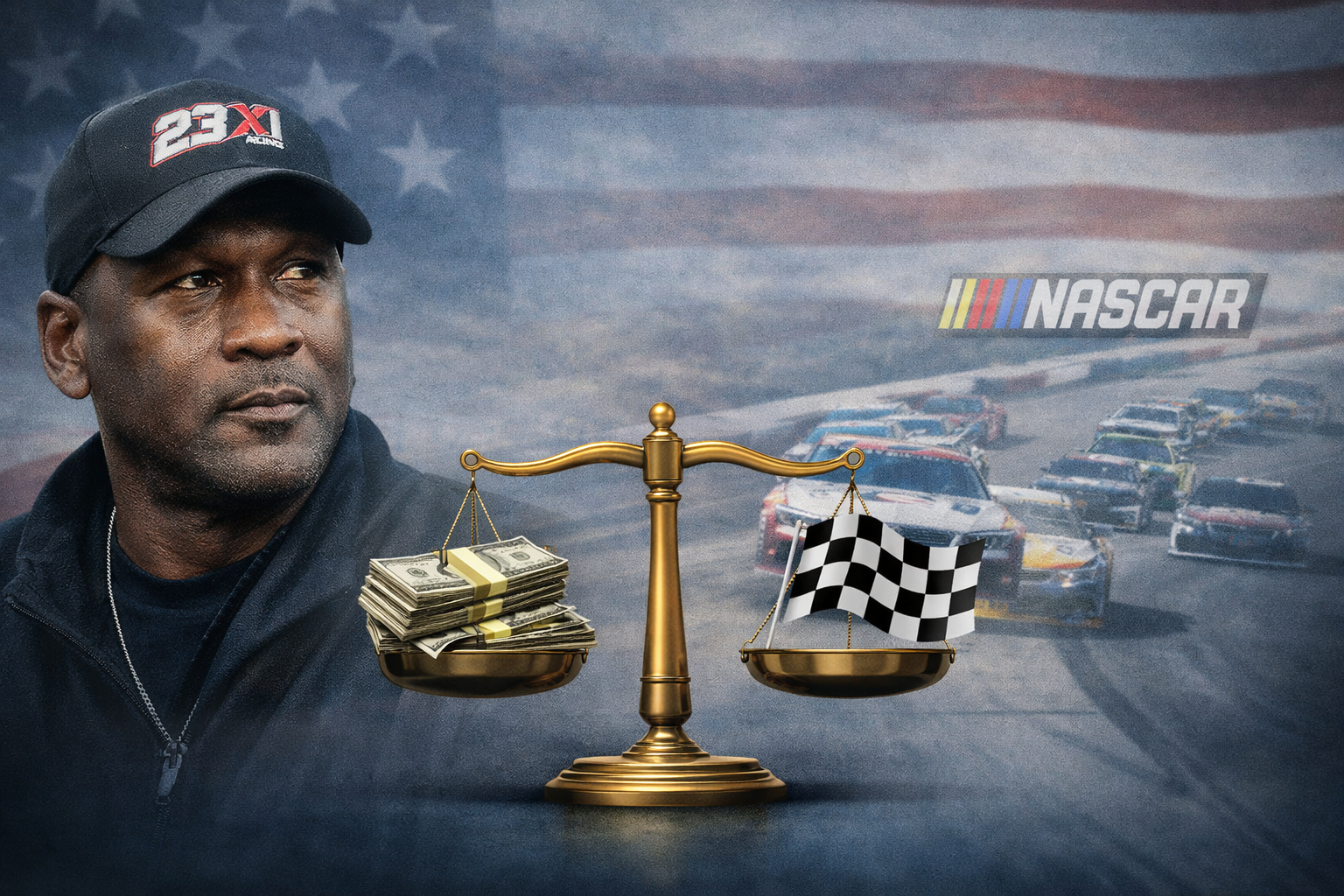
Michael Jordan’s NASCAR lawsuit focuses on fairness, revenue, and access. Here’s how competitive balance fits into the broader discussion.
Michael Jordan’s lawsuit is not about race results
NASCAR has built its identity around parity.
Equal parts. Tight rules. Controlled costs.
On paper, that should create a level playing field where every team has the same opportunity to compete.
That idea is central to how the sport presents itself. Fans expect close racing, unpredictable outcomes, and a field where performance is determined on track rather than built long before the green flag.
But the lawsuit involving Michael Jordan, through 23XI Racing, is not questioning who wins on Sunday.
It is questioning whether every team has a realistic path to compete over time.
That distinction matters.
Because while a single race may appear balanced, the structure behind the sport ultimately determines who can sustain performance across an entire season, and over multiple years.
That is where the conversation around competitive balance actually begins.
What Michael Jordan’s lawsuit is actually about
Through 23XI Racing, Jordan is challenging aspects of NASCAR’s business structure rather than the competition itself.
The lawsuit focuses on several core areas:
- Revenue distribution across teams
- The structure and control of the charter system
- Limitations placed on team growth and long-term opportunity
These are not new topics within motorsports, but they are being brought into sharper focus through this legal action.
At the center of the argument is a simple question: does the current system allow all teams to build toward sustained competitiveness, or does it create limitations that are difficult to overcome?
The lawsuit does not claim that races are decided unfairly.
Instead, it looks at how financial structure, access, and control influence what happens over time.
In that sense, the discussion is less about competition itself and more about the conditions that shape it.
Competitive balance is part of the conversation
While the lawsuit is centered on business structure, it naturally connects to how competition plays out on track.
Even within a standardized system, teams operate at different levels of depth and support.
In general terms, that can influence:
- How quickly a team recovers from damage during a race weekend
- The number of fully prepared cars available across a season
- The level of engineering, simulation, and data behind each entry
- The ability to maintain consistency from week to week
These differences are not written into the rulebook, but they exist in practice.
And over time, they can shape results in a way that is not always immediately visible.
A single race may come down to execution in the moment.
A full season often reflects the strength of the organization behind the car.
Depth and consistency over a full season
One of the less visible aspects of NASCAR competition is how teams manage the demands of a full schedule.
Each race presents its own variables, but the season as a whole requires sustained performance.
Teams with greater resources are generally better positioned to:
- Rotate cars and equipment without sacrificing performance
- Replace damaged components quickly and effectively
- Maintain consistent preparation standards each week
- Provide drivers with deeper technical support and feedback
Other teams may operate with fewer options, requiring more recovery and adaptation as the season progresses.
This does not change the fairness of individual races.
But it can influence how performance trends develop over time.
Consistency becomes a separating factor, and consistency is often tied to depth.
Parity in rules does not always mean parity in execution
NASCAR’s current model, including the Next Gen car, was designed to reduce performance gaps across the field.
It introduced:
- More standardized components
- Reduced opportunities for custom development
- Greater cost control across teams
These changes have helped tighten competition and bring teams closer together in terms of equipment.
However, standardization does not eliminate differences in execution.
Teams still vary in:
- Preparation processes
- Engineering interpretation
- Personnel experience
- Organizational structure
Even when the components are the same, how they are used can differ.
The framework may be equal, but execution remains a variable.
Why this matters beyond one lawsuit
Jordan’s position highlights a broader question that applies across all forms of motorsport:
What does fairness actually mean?
Is it:
- Equal rules for every competitor?
- Equal financial opportunity to grow?
- Or equal ability to compete consistently over time?
Each definition leads to a different perspective.
From a regulatory standpoint, NASCAR provides a controlled and structured environment.
From a competitive standpoint, outcomes can still reflect differences in how teams operate within that structure.
The lawsuit does not suggest that NASCAR lacks fairness in a traditional sense.
Instead, it raises the question of whether fairness at the rule level translates into fairness over the long term.
The role of structure in long-term competition
Motorsports has always involved a balance between regulation and resource allocation.
Rules are designed to manage cost and maintain competition, but teams still function within those rules based on their capabilities.
Over time, structure influences outcomes.
Revenue, access, and operational flexibility all contribute to how teams evolve.
Teams that can invest in infrastructure, personnel, and preparation are often better positioned to sustain performance.
Teams with fewer resources may still compete effectively in moments, but maintaining that level over time can be more difficult.
Jordan’s involvement brings attention to this structural layer.
Not as a critique of individual teams or race results, but as part of a broader discussion about how the system shapes opportunity.
The connection between structure and competition
The relationship between structure and competition is not always direct, but it is consistent.
When teams have access to greater resources, they can:
- Prepare more effectively
- Respond more quickly to setbacks
- Maintain higher levels of consistency
When resources are more limited, teams may rely more heavily on efficiency and adaptability.
Both approaches exist within the same rulebook.
But over time, differences in structure can influence competitive outcomes.
This is not unique to NASCAR.
It is a common dynamic across motorsports.
What makes it notable here is the emphasis NASCAR places on parity.
That contrast brings additional attention to how the system operates beneath the surface.
The takeaway
NASCAR continues to evolve in how it balances competition, cost, and opportunity.
The discussion raised by Michael Jordan and 23XI Racing adds another layer to that evolution.
It is not about changing who wins on a given weekend.
It is about how the structure of the sport shapes who has the ability to compete consistently over time.
And in a sport built on parity, that question carries weight far beyond a single lawsuit.
It speaks to the long-term direction of the sport, and how competitive balance is defined not just by rules, but by the system that supports them.

Websites, hosting, email & digital tools for growing brands.