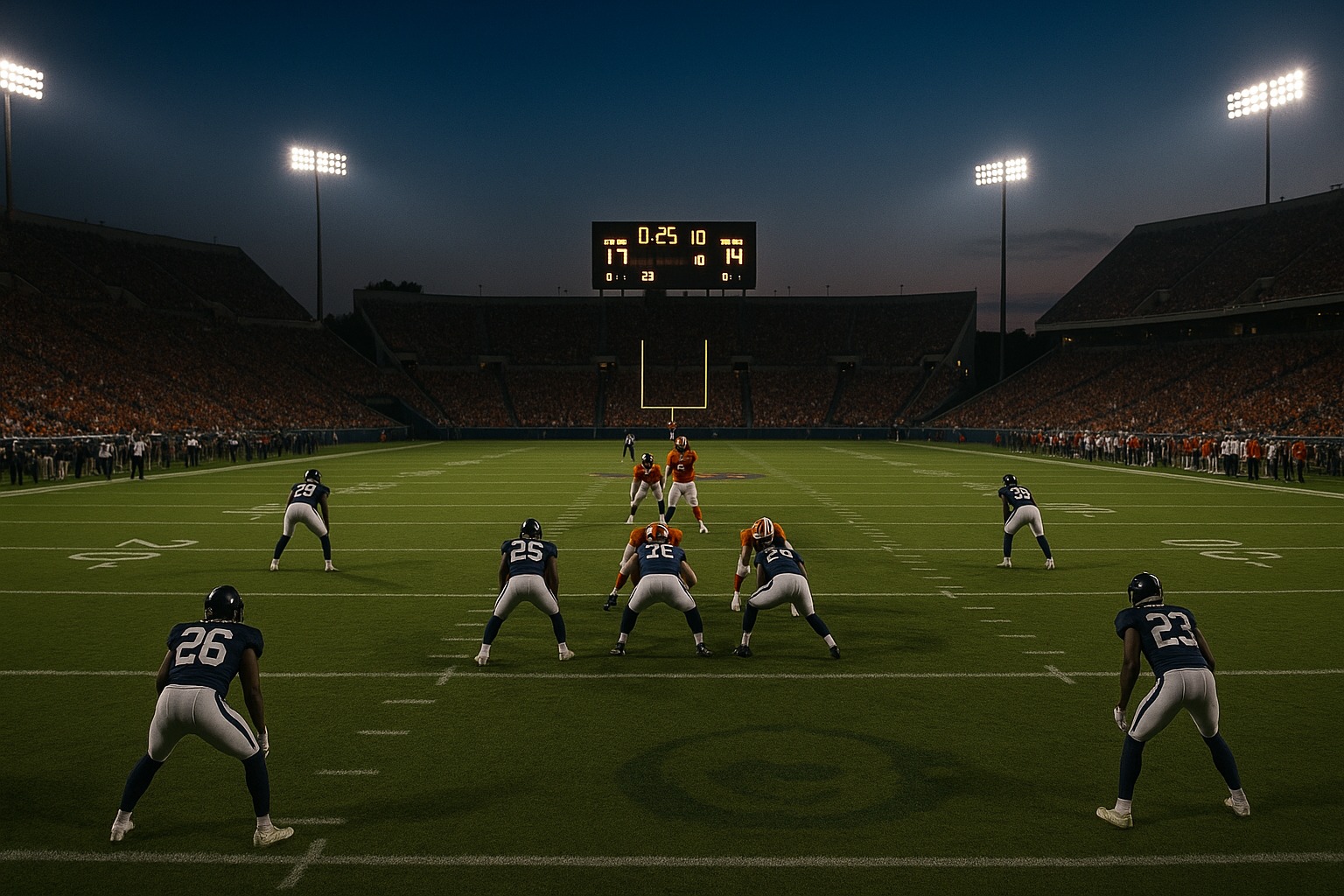
The Flaws of Prevent Defense
In the high-stakes world of American football, the prevent defense has become a polarizing strategy, often criticized for handing games away rather than securing victories in both the NFL and college football. Designed to prioritize clock management by preventing big plays, this defensive scheme drops players into deep coverages, conceding short and intermediate passes. While the intent is to force offenses to burn time, the reality is often a swift march into field goal range, turning potential wins into heartbreaking losses.
NFL Context
Data underscores the issue in the NFL. In the 2023 season, prevent defenses deployed in the final two minutes of close games (within 8 points) allowed an average of 6.7 yards per play, compared to 5.4 yards for standard defenses, according to NFL Next Gen Stats. Since 2018, 68% of game-tying or go-ahead field goals in the final minute were surrendered against prevent defenses. Recent examples, like the 2022 Minnesota Vikings’ collapse against the Giants or the 2024 Atlanta Falcons’ loss to the Chiefs, highlight how quickly teams can exploit the cushion, reaching midfield or closer in just a few plays. With modern kickers routinely nailing 40- to 50-yard field goals (85% success rate league-wide in 2024), conceding this territory is a recipe for disaster.
A fresh illustration came in the September 14, 2025, matchup between the Dallas Cowboys and New York Giants, a 40-37 overtime thriller won by Dallas. In the final minute of regulation, the Giants shifted to a softer, prevent-style coverage, allowing Dak Prescott to advance the Cowboys from their own territory to the New York 46-yard line in just 25 seconds. This positioned Brandon Aubrey for a 64-yard field goal to force overtime. In overtime, the Giants again employed prevent principles, emphasizing deep coverage over shorter routes. Prescott capitalized with key completions, including a 27-yard pass to George Pickens and a 14-yard scramble, setting up Aubrey’s game-winning 46-yard field goal. The Giants’ 14 penalties for 160 yards exacerbated the defensive lapses, but the prevent scheme undeniably handed Dallas the opportunities to seize victory.
College Football Context
In college football, the prevent defense is even less effective due to the sport’s unique dynamics. High-powered, spread offenses and up-tempo schemes dominate, with teams like 2024 Oregon and 2025 USC averaging over 40 points per game (NCAA stats). These offenses exploit the soft zones of prevent defenses with quick passes or designed runs by mobile quarterbacks. In 2024, FBS teams facing prevent defenses in the final two minutes of close games (within 7 points) allowed 7.2 yards per play, compared to 5.8 for standard defenses, per Sports Info Solutions. College kickers, with a 78% success rate on 40- to 50-yard field goals in 2024, make reaching midfield a near-guaranteed scoring opportunity.
For example, in the 2024 Alabama vs. Georgia game, Georgia’s late shift to a prevent-style defense allowed Alabama to march from their own 30 to the Georgia 42 in 28 seconds, setting up a game-tying 59-yard field goal. Similarly, in 2025, Texas A&M’s loss to Notre Dame saw their prevent defense surrender 15+ yard completions due to misaligned zones, enabling a rapid drive into field goal range. The college game’s faster pace and less disciplined defenses due to younger players and less coaching continuity amplify these breakdowns, as secondaries often misread routes or fail to close gaps.
The prevent defense’s passive approach clashes with the aggressive, high-scoring nature of modern football at both levels. Offenses led by quarterbacks like Patrick Mahomes in the NFL or Caleb Williams in college thrive in these scenarios, picking apart soft zones with quick passes to efficient playmakers. The strategy’s reliance on the offense making mistakes or running out of time ignores the precision and discipline of today’s attacks.
Stick to What Got You There
Instead of shifting to a prevent defense, teams should lean into the aggressive, disciplined schemes that define their identity throughout the game. The mantra “play what got you there” emphasizes maintaining the defensive principles that earned a lead in the first place. Whether it’s a blitz-heavy approach, tight man coverage, or a balanced zone scheme, sticking to a team’s core strategy keeps the offense guessing and disrupts its rhythm.
NFL Examples
In the NFL, the 2023 Philadelphia Eagles, known for their ferocious pass rush, maintained pressure in late-game situations, leading to a league-low 12% conversion rate on third-and-long plays against them in the fourth quarter. Teams like the 2024 San Francisco 49ers, with their versatile 4-3 scheme, have also shown success by staying aggressive, forcing turnovers or incompletions rather than ceding easy yards. By contrast, teams that switch to prevent often see their pass rush vanish, allowing quarterbacks ample time to find open receivers.
College Examples
In college football, teams like 2024 Michigan have succeeded by sticking to their identity. Their relentless pass rush led to a 65% sack rate on third downs in the fourth quarter, disrupting tempo-driven offenses. Similarly, 2025 Alabama’s use of mixed coverages in late-game situations against Auburn forced two incompletions and a turnover, preserving a narrow lead. Maintaining an aggressive defense doesn’t mean reckless abandon it’s about calculated risks, like mixing coverages or disguising blitzes, to force offenses to execute perfectly under duress. As Bill Belichick once noted, “You don’t win games by playing not to lose.” Teams that abandon their identity risk losing the momentum that defined their performance for the first 58 minutes.
A Hybrid Alternative: The Adaptive Defense
Rather than defaulting to prevent, teams at both levels should adopt a hybrid, adaptive defense in late-game situations. This approach blends aggression with situational awareness, tailored to the opponent’s strengths and the game’s context.
Key components include:
1. Selective Pressure: Maintain a pass rush with strategic blitzes or simulated pressures to disrupt the quarterback’s timing. For example, sending a slot corner or linebacker on a delayed blitz can force hurried throws without leaving deep zones exposed.
2. Dynamic Coverages: Mix man and zone coverages to confuse the quarterback. Disguising a Cover 2 as a Cover 4, for instance, can bait an overconfident throw into a waiting safety’s hands.
3. Clock-Aware Positioning: Tighten coverage in the short-to-intermediate range (5-15 yards) to contest quick passes, forcing the offense to burn more plays to reach field goal range. This preserves the clock-draining benefit of prevent without surrendering massive chunks of yardage.
4. Situational Awareness: Adjust based on the opponent’s personnel and tendencies. Against a team with a strong deep threat, prioritize safety help over the top. Against a dink-and-dunk offense, press receivers at the line to disrupt timing.
Successful Implementation
The 2024 Baltimore Ravens provide an NFL blueprint. In a Week 5 win over the Bengals, they faced a late-game drive with a 6-point lead. Instead of going full prevent, they mixed zone coverages with occasional blitzes, forcing Joe Burrow into two incompletions and a sack, burning clock and preserving the win. This adaptive approach limited Cincinnati to just 4.8 yards per play, well below the prevent defense average. In college, 2025 Georgia’s defense against Florida used a similar hybrid approach, mixing tight man coverage with selective blitzes to force a late interception, sealing a 34-31 victory.
When Prevent Defense Works
Prevent defense can have limited success in specific scenarios. In the NFL, it’s viable with under 30 seconds remaining, no timeouts, and a quarterback with limited arm strength, forcing low-percentage throws. In college, it can work against inexperienced quarterbacks or run-heavy option teams, baiting mistakes under pressure. Elite secondaries, like 2024 Iowa or 2025 Georgia, can also execute prevent better due to superior coverage skills. However, these situations are exceptions, as most modern offenses are built to exploit the space prevent defenses concede.
The Path Forward
The prevent defense’s flaws are rooted in its passivity, which clashes with the offensive evolution in both the NFL and college football. Teams must embrace their defensive identity and adapt intelligently, not retreat into a shell that invites failure. By blending aggression, versatility, and situational awareness, defenses can protect leads without handing games away. The data is clear, and the stakes are high teams at both levels must evolve beyond the prevent defense to secure victories in crunch time.


Websites, hosting, email & digital tools for growing brands.