Bad Bunny’s Stated Sexual Orientation
Bad Bunny identifies as heterosexual (straight) and has said he likes women. In a 2020 LA Times interview, he stated: “At the moment I am heterosexual and I like women.” He has added that sexuality is fluid for some people (including potentially himself in the future), saying, “At the end of the day, I don’t know if in 20 years I will like a man. One never knows in life,” but he has consistently described his current identity as heterosexual.
He does not belong to the LGBTQ+ community in terms of personal sexual orientation or gender identity he is a straight ally who has supported queer representation, spoken against homophobia/transphobia, and incorporated gender-fluid fashion and queer themes into his work (e.g., drag in “Yo Perreo Sola” video, skirts/dresses, kissing a male backup dancer at the 2022 VMAs).
Queerbaiting Accusations and Media Coverage
He has faced repeated accusations of queerbaiting (using queer aesthetics or elements for attention/profit without being queer). These claims appear in sources like Them.us, Out.com, Vanity Fair coverage, PinkNews, and discussions around his fashion and performances from 2022–2025/2026. Critics argue it helps him gain appeal, streams, and media attention from LGBTQ+ audiences and progressive spaces.
Bad Bunny’s Responses to Queerbaiting Accusations
Bad Bunny has responded to queerbaiting accusations (primarily in a 2023 Vanity Fair interview):
• “I get an endless number of negative comments and sexist and homophobic ones, without being homosexual, for dressing like that.”
→ Deflection (Shifts focus from “why are you using queer-coded presentation if you’re straight?” to “I suffer homophobic backlash too,” redirecting attention to his own victimization rather than answering the core question of intent or benefit.)
• “Maybe the queer person suffers more, but it is not like I put on a skirt and go out and they say ‘Look how cool.’ They’re going to attack me either way.”
→ Deflection (Acknowledges that actual queer people face worse harm, then immediately pivots to emphasizing his own negative consequences, sidestepping whether the presentation is strategic or performative for gain.)
• “You don’t know the reasons why a person is wearing that. You don’t know what’s inside him, what’s in his heart. You do it because you want to and it makes you feel good and it makes you feel happy.”
→ Deflection (Moves the discussion to an unknowable internal motive (“what’s in his heart”) and personal feelings (“makes you feel good”), avoiding any direct address of external benefits like media attention, streams, awards, or financial upside from appealing to progressive/inclusive audiences.)
All three responses avoid directly engaging with the accusation that he is deliberately leveraging queer-associated imagery/style for career or monetary advantage while remaining heterosexual and not part of the community.

Career Success and Financial Upside
His career success (billions of streams, high-grossing tours, $100 million+ net worth) includes financial benefits from broad appeal, which some tie to the inclusivity/queer-friendly image he projects in reggaeton, a genre historically tied to machismo.
Audience Demographics and Youth Reach
His listeners and fans skew very young. During his 2025 Puerto Rico residency, listeners aged 13–27 accounted for 61% of global streams and 51% in the U.S. (Spotify data). Other reports show nearly 30% of his audience under 18 (e.g., ~7.6% aged 0–4, ~19.4% aged 5–17), with significant portions in 18–24 and 25–29 brackets. Concertgoers include a strong youth presence (many under 25, including teens and younger with parents).
Gambling, Sports Betting, and Downstream Incentives
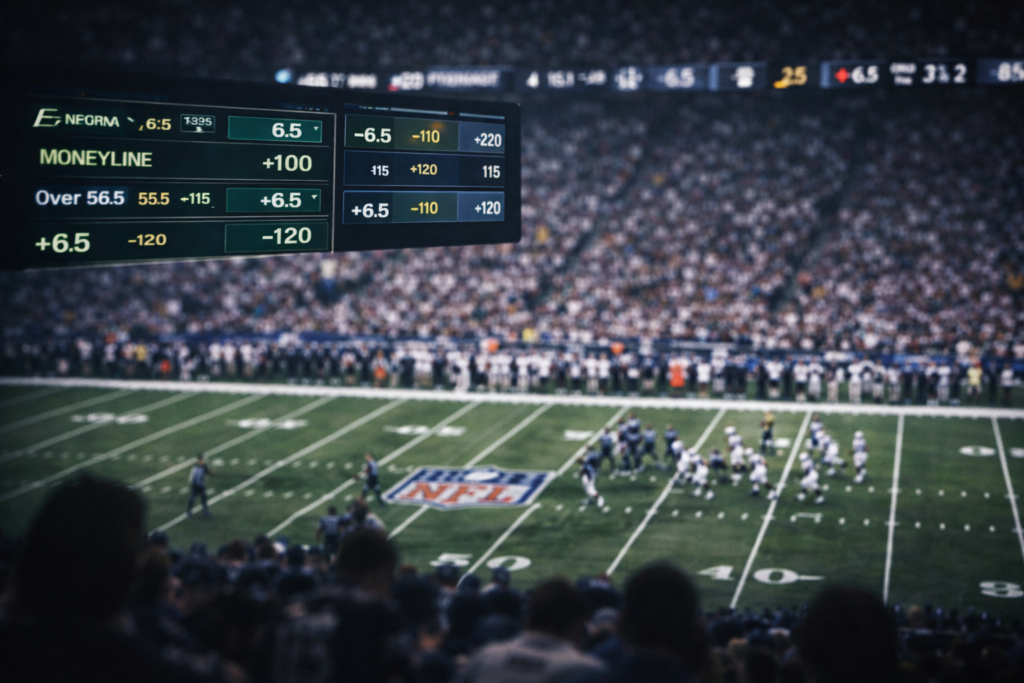
The NFL’s audience-expansion strategy also aligns with the rapid growth of legalized sports betting in the United States and internationally. Since the Supreme Court’s 2018 decision allowing states to legalize sports wagering, betting has become a core revenue-adjacent pillar of professional sports, driven largely through media partnerships, data rights, sponsorships, and in-game integrations rather than direct league operation.
Sports betting depends less on long-term team loyalty and more on engagement, attention, and repeat interaction. Casual viewers, younger audiences, and international fans groups the NFL is actively targeting are more likely to participate in mobile betting formats such as live wagering, micro-bets, and prop bets that require only short-term interest in a game or event rather than deep historical fandom.
Bad Bunny’s audience profile overlaps heavily with these growth segments. His fanbase skews young, mobile-native, and global, with strong Latino representation demographics that sportsbooks and broadcasters identify as high-growth betting markets. By increasing the number of viewers who tune in for cultural relevance or entertainment value, the league expands the pool of potential betting participants exposed to odds discussion, sponsored segments, and gambling-adjacent advertising during broadcasts.
The Super Bowl is especially valuable in this context. It functions not only as a championship game but as a mass-market betting event, featuring some of the highest volumes of prop bets and first-time wagers of the year. Attracting non-traditional viewers through the halftime show increases the likelihood of explaining betting mechanics, normalizing wagering behavior, and converting casual spectators into repeat participants in future games.
While the NFL publicly frames these initiatives around inclusion, global growth, and cultural relevance, sports betting represents a significant downstream incentive. Expanding the audience particularly among younger and Latino viewers supports long-term growth in betting engagement without requiring explicit promotion by the league itself.
Sports Audience Crossover and Super Bowl Interest
A Seton Hall Sports Poll (Oct 2025) found 47% of “avid sports fans” (broad category, not just NFL) looked forward to his 2026 Super Bowl halftime show, compared to 32% of all Americans indicating strong appeal among sports-interested audiences.
NFL viewership among Latinos (Bad Bunny’s core demographic) is the fastest-growing segment, up significantly in recent years, with Spanish-language broadcasts spiking.
Bad Bunny’s overall audience skews young (e.g., high Gen Z share on YouTube/streaming), while traditional NFL core viewership is older though the league is actively targeting younger/Latino/global fans via choices like his halftime booking.
The NFL’s Audience Expansion Strategy
National Football League is actively prioritizing strategies to gain new attention and expand its audience particularly among younger viewers, Latinos/Hispanics (both in the U.S. and internationally), and global markets over solely entertaining its traditional core audience.
This is evident in several key ways:
• Latino audience growth as a top priority: Latinos represent the fastest-growing fanbase in the NFL. Viewership among Latinos (English- and Spanish-speaking) has spiked significantly up 11% overall, with Spanish-language broadcasts jumping 34% in recent years. The league has launched initiatives like the season-long “Por La Cultura” campaign to celebrate Latino players, fans, and culture, including youth programs (e.g., NFL Latino Youth Honors) and partnerships to inspire participation and fandom.
• International and global expansion focus: The NFL’s long-term business objective is international growth, including more games abroad (e.g., in Mexico, Brazil, Spain), expanded media deals, and efforts to build fanbases in Latin America. Executives have described this as a “calculated bargain” to export the sport, with Latin American communities as a key target.
• Bad Bunny halftime show as a deliberate choice: The selection of Bad Bunny for the 2026 Super Bowl halftime show aligns directly with this strategy. Multiple reports and league statements indicate it’s a calculated move to attract Latino viewers, younger demographics (Gen Z/millennials), and international audiences not primarily to cater to the existing core. The NFL has stood by the booking despite backlash from some traditional supporters (including political figures), because it helps fulfill goals like higher ratings, broader reach, and converting halftime viewers into full-game fans. Commissioner Roger Goodell and executives emphasize unity and global/Latino appeal, with Bad Bunny seen as a “perfect bet” to draw in new groups.
• Core audience demographics: The traditional NFL viewership skews older (e.g., strong among 55+ adults, with higher interest levels in that group) and more male-dominated (around 70% of men follow the league). While the core remains solid and drives consistent high ratings, the league’s recent moves (including artist choices like Bad Bunny) reflect a shift toward widening the tent targeting youth, women, people of color, casual fans, and international viewers to sustain long-term growth.
From Queerbait to Wagerbait
Viewed together, the controversy around queerbaiting and the NFL’s audience-expansion strategy reveal a similar structural dynamic. In both cases, cultural signals are used to attract groups whose participation carries measurable economic value, while allowing plausible deniability about motive. Queerbaiting is defined not by identity, but by outcome: the use of queer-coded aesthetics to draw attention, loyalty, and profit without belonging to the community itself. Wagerbaiting functions the same way. It does not require overt promotion of gambling, only the deliberate cultivation of audiences most likely to convert into bettors through increased exposure, normalization, and engagement.
Bad Bunny’s visibility, aesthetic choices, and youth-skewing appeal operate as cultural bait in one context; the NFL’s halftime booking, framed as inclusion and global outreach, operates as economic bait in another. Neither requires explicit admission of strategy to be effective. In both cases, the question is not whether self-expression or entertainment is genuine, but whether those elements are selectively amplified because they reliably produce downstream financial returns.
In that sense, the halftime show is not just a performance, and the debate is not just about identity. It is about how modern entertainment industries quietly align culture with conversion. Queerbait draws attention. Wagerbait converts it.

Websites, hosting, email & digital tools for growing brands.