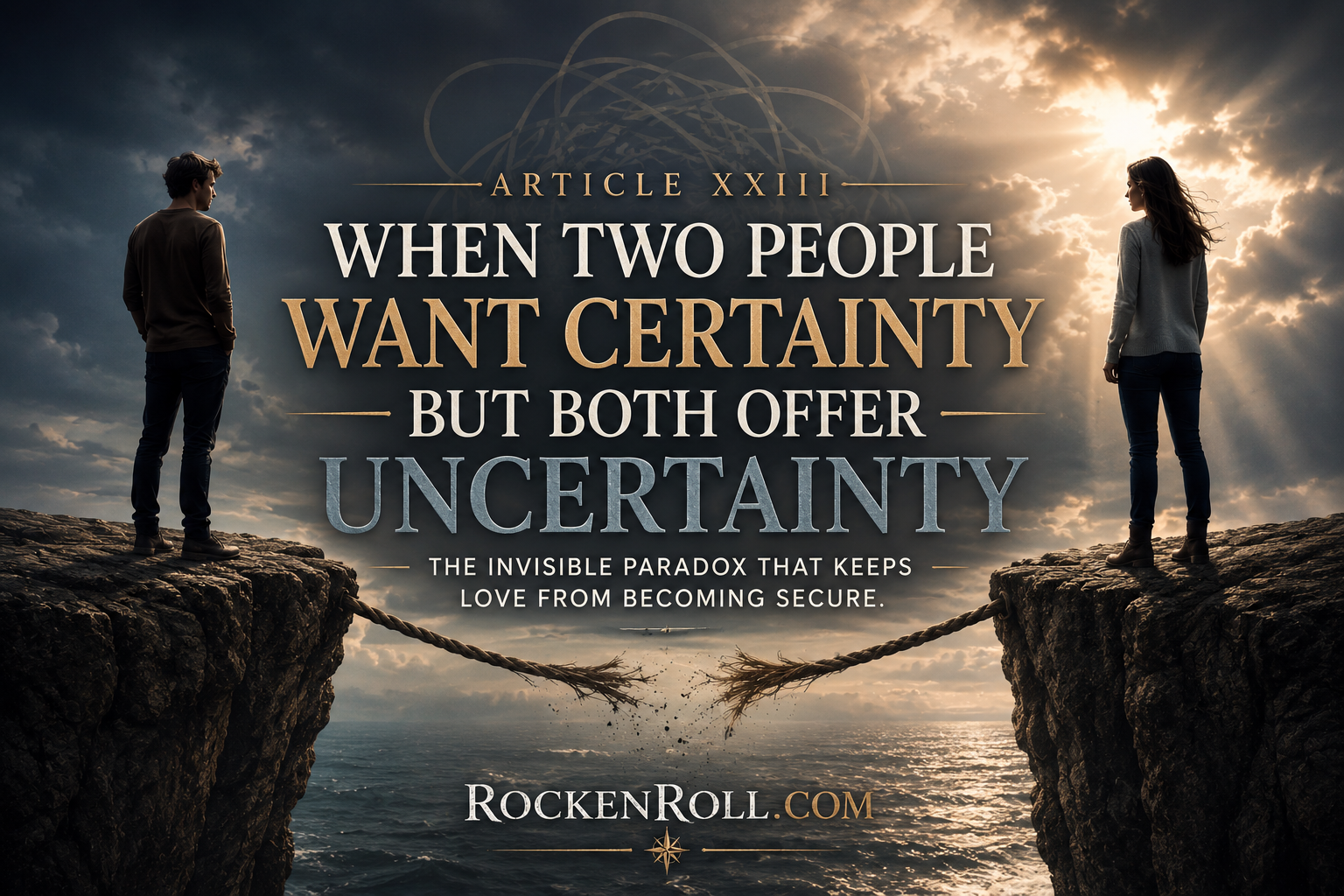
The Certainty Paradox
Two people can want exactly the same thing and still make it impossible for each other to provide it.
Both want security.
Both want reassurance.
Both want to know where they stand.
Both want to believe the other person is fully invested.
Neither wants to risk discovering they cared more.
So each waits.
One thinks:
Show me you’re certain about me, and I’ll become certain about you.
The other is thinking exactly the same thing.
Neither recognizes the trap.
They are both demanding evidence that can only be created by the very vulnerability neither is willing to offer first.
This is the certainty paradox.
And it can quietly destroy relationships between two people who genuinely care about each other.
Two People Standing at the Same Door
Uncertainty is often misunderstood as a lack of feeling.
Sometimes it is.
But sometimes there is enormous feeling underneath it.
What is missing is movement.
Imagine two people standing on opposite sides of an open doorway.
Both want the other person to enter.
Neither wants to step through first.
One says:
“If you really wanted this, you would come toward me.”
The other thinks:
“If you really wanted this, you would come toward me.”
So they remain exactly where they are.
Eventually, each person’s stillness becomes evidence against the other.
“See?”
“I knew you weren’t sure.”
Neither realizes they are looking at a reflection.
The Risk Nobody Wants to Take First
Every meaningful relationship eventually requires someone to assume emotional risk without knowing exactly what will happen next.
There is no way around it.
You can gather information.
You can observe behavior.
You can communicate.
You can take your time.
But eventually, intimacy requires something that cannot be completely insured against loss.
Vulnerability.
The problem begins when both people want the other to assume more of that risk.
One wants a declaration before making a decision.
The other wants a decision before making a declaration.
One wants commitment before becoming fully vulnerable.
The other wants vulnerability before offering commitment.
Each position makes sense individually.
Together, they create paralysis.
Both people are waiting for a guarantee from someone who is waiting for the same guarantee from them.
Conditional Vulnerability
This creates a strange form of intimacy.
Both people are open.
But only conditionally.
They reveal enough to maintain connection.
Not enough to become completely exposed.
They express affection…
then qualify it.
Talk about the future…
then retreat from it.
Move closer…
then create distance.
They may not consciously be playing games.
They may genuinely believe they are being careful.
But caution has consequences.
When vulnerability becomes conditional, the other person never receives a clear emotional signal.
Instead, they receive a sequence of contradictions.
Come closer.
Not that close.
I want you.
But I don’t know.
Don’t leave.
But don’t ask me to choose.
Eventually, the relationship becomes emotionally exhausting not because there is no love…
but because nobody knows what the love is allowed to become.
Words Move Forward While Behavior Moves Backward
One of the most destabilizing experiences in a relationship is receiving two different messages from the same person.
Words say:
“You matter to me.”
Behavior says:
“But I am protecting myself from choosing you.”
Words say:
“I can’t imagine losing you.”
Behavior says:
“But I can’t give you confidence that I’m staying.”
Words say:
“I want us.”
Behavior says:
“But I need to keep my options emotionally open.”
None of those statements necessarily means someone is lying.
That is what makes uncertainty so difficult.
A person can sincerely mean what they say…
and still behave in ways that contradict it.
The other person is then forced to decide which message to believe.
Most eventually believe behavior.
The Relationship Becomes an Observation Deck
Something subtle happens when uncertainty lasts too long.
People stop participating in the relationship.
They start evaluating it.
Every interaction becomes data.
Who reached out first?
How affectionate were they?
Did they mention the future?
Did they seem distant?
Why did they phrase that sentence that way?
Was that hesitation?
Was that reassurance?
Was that withdrawal?
The relationship becomes something both people are constantly studying.
They are no longer simply experiencing each other.
They are monitoring each other.
And the more they monitor, the less natural the relationship becomes.
Spontaneity disappears.
Every action carries meaning.
Every silence becomes evidence.
Every change in tone becomes a clue.
Two people who once simply enjoyed being together become analysts of their own relationship.
Uncertainty Creates Hypervigilance
The human mind does poorly with unresolved emotional ambiguity.
When something important remains uncertain, attention increases.
You begin noticing everything.
A delayed response.
A different tone.
A change in routine.
A shorter goodbye.
An unusually affectionate moment.
The brain begins searching for patterns because patterns might provide the certainty the relationship itself is not providing.
But hypervigilance rarely creates clarity.
It creates interpretation.
And interpretation is heavily influenced by fear.
One person sees distance where there may only be fatigue.
Another sees rejection where there may only be distraction.
Small moments become disproportionately important because the larger question remains unanswered.
Are we actually choosing each other?
When that question remains unresolved long enough, almost everything starts feeling like an answer.
Both People Begin Protecting Their Exit
Eventually uncertainty changes behavior.
Not dramatically.
Quietly.
One person shares a little less.
The other stops asking as many questions.
One stops talking about the future.
The other becomes more independent.
Plans become shorter-term.
Expectations become smaller.
Emotional investment becomes carefully managed.
Neither necessarily wants the relationship to end.
They are preparing themselves in case it does.
This creates one of the cruelest dynamics in relationships.
Both people begin withdrawing because they are afraid the other person might withdraw.
Their protection becomes the very evidence that confirms each other’s fear.
The Self-Fulfilling Collapse
This is how uncertainty can manufacture its own proof.
One person senses hesitation.
So they protect themselves.
The other senses that protection as distance.
So they become less certain.
The first person notices the increased uncertainty.
So they withdraw further.
Eventually the relationship deteriorates.
And both people walk away believing:
“I knew it.”
“I knew they weren’t fully committed.”
What neither may understand is that they helped create the outcome they feared.
The relationship didn’t necessarily collapse because certainty was impossible.
It may have collapsed because both people waited for certainty before behaving with certainty.
Wanting Certainty Is Not the Same as Offering It
This distinction matters.
Almost everyone wants certainty.
Far fewer understand what it means to provide it.
Certainty is not saying:
“I love you.”
It is not saying:
“I don’t want to lose you.”
It is not saying:
“You mean everything to me.”
Those statements can be deeply sincere.
But certainty is experienced through alignment.
What you say.
What you choose.
What you prioritize.
What you repeatedly do.
When those things point in the same direction, another person can relax.
When they point in different directions, uncertainty survives no matter how beautiful the words are.
Certainty Does Not Mean Guarantee
This is where people often become trapped.
They think certainty requires knowing the future.
It doesn’t.
No relationship comes with that guarantee.
People change.
Circumstances change.
Life intervenes.
Certainty is not:
“I promise nothing will ever happen to us.”
Certainty is:
“I know what I am choosing now, and my behavior reflects that choice.”
That is a completely different standard.
You do not need to know where you will be twenty years from now to stop making someone guess where they stand today.
Mature certainty accepts risk.
Immature certainty demands guarantees before taking any.
The Problem With Keeping One Foot Outside
Some people try to solve uncertainty by preserving alternatives.
Emotionally.
Socially.
Practically.
They tell themselves they are simply being realistic.
They do not want to close every door until they know which one is safe.
But relationships feel the presence of an open exit.
You cannot fully experience being chosen by someone who appears to be continually evaluating whether they should choose something else.
And you cannot ask another person to stand firmly beside you while you remain positioned to leave.
That does not mean people should stay in relationships that are wrong for them.
It means indecision has an emotional cost.
Sometimes uncertainty is information.
Sometimes it means the relationship truly is not right.
But when uncertainty becomes a permanent operating system, it prevents either person from discovering what the relationship might have become without it.
Two Good People Can Still Create an Unsafe Relationship
Not every painful relationship has a villain.
This matters.
Two people can be kind.
Honest.
Loving.
Well-intentioned.
And still create an emotionally unstable environment together.
One may fear abandonment.
The other may fear making the wrong choice.
One seeks reassurance.
The other experiences reassurance as pressure.
One moves closer.
The other needs space.
That space creates fear.
Fear creates pursuit.
Pursuit creates more distance.
Nobody is trying to manipulate anyone.
Yet the system they create together becomes painful.
Sometimes the problem is not either person individually.
It is the pattern formed between them.
The Asymmetry of Risk
There is another uncomfortable truth.
People often want certainty without wanting equal exposure.
They want the other person to say:
“I’m all in.”
While preserving their own ability to say:
“I’m still figuring this out.”
They want someone else to close the door behind them first.
That creates an imbalance.
One person becomes responsible for proving the relationship is safe enough for both.
That cannot last.
Healthy commitment cannot be built by one person repeatedly demonstrating certainty while the other continually evaluates it.
Eventually the person carrying the risk becomes exhausted.
Certainty has to become reciprocal.
Not necessarily at exactly the same moment.
But eventually.
Sometimes the Question Is the Problem
People living inside prolonged uncertainty often ask:
“How can I know for sure?”
Sometimes that question has no answer.
There may never be enough evidence.
Enough reassurance.
Enough time.
Enough conversations.
Because absolute certainty about another human being does not exist.
The better question may be:
“What am I willing to choose based on what I know now?”
That question returns responsibility to the person asking it.
It stops making someone else responsible for eliminating every possible risk.
At some point, relationships require decisions.
Not endless evaluation.
The Courage to Become Clear
Clarity can be frightening because clarity creates consequences.
If you say:
“I choose this,”
you become vulnerable to losing it.
If you say:
“I don’t choose this,”
you become vulnerable to regretting it.
Uncertainty postpones both risks.
That is why people can remain there for months.
Sometimes years.
Ambiguity feels safer because nothing is completely decided.
But nothing is completely built either.
Eventually uncertainty stops being neutral.
It becomes a decision of its own.
When Two People Want Certainty but Both Offer Uncertainty
Perhaps the hardest relationships are not always the ones without love.
Sometimes they are the ones with enormous love…
and insufficient clarity.
Two people can care deeply.
Miss each other terribly.
Feel extraordinary connection.
Imagine a future.
Fear losing each other.
And still create an environment where neither person feels securely chosen.
That contradiction can exist.
Love does not automatically resolve uncertainty.
Sometimes it intensifies it because there is more to lose.
The answer is not demanding bigger promises.
It is recognizing the paradox.
You cannot continually ask:
“Are you sure about me?”
while making the other person continually wonder:
“Are you sure about me?”
You cannot demand certainty from someone while making them live inside your uncertainty.
At some point, someone has to stop collecting evidence.
Stop waiting for the perfect guarantee.
Stop asking the other person to assume all the emotional risk.
And become clear.
Not recklessly.
Not blindly.
But deliberately.
Because certainty in relationships is rarely something two people suddenly discover waiting for them.
It is something they create through choices that repeatedly say the same thing.
I am here.
I am choosing this.
I am willing to see where we can take it.
And perhaps that is the deepest paradox of all.
Two people can spend years waiting for each other to provide the certainty they both desperately want…
without ever realizing that certainty was something they had to create together.
Continue Reading in The Damaged and the Broken:
- Article XXIV: 7/29/26
- Article XXII: The Outer Extremities of Society
- Article XXI: The Relationship You Stop Trying to Win
- Article XX: What Healthy Love Actually Feels Like
- Article XIX: When Peace Starts Feeling Unfamiliar
- Article XVIII: The Difference Between Being Chosen and Being Needed
- Article XVII: The Relationship That Doesn’t Exhaust You
- Article: XVI: The Moment You Stop Explaining Yourself
- Article XV: They Don’t Lean In. They Take It Out On You.
- Article XIV: They Don’t Lean In. They Take It Out On You.
- Article XIII: When Healthy Love Feels Dangerous
- Article XII: They Don’t Slow Things Down. They Reset Control.
- Article XI: You Think It’s Connection. It’s Control.
- Article X: You Think It’s Connection. It’s Control.
- Article IX: It Doesn’t Stay Outside the Relationship
- Article VIII: You Don’t Say What Changed
- Article VII: You Don’t Sit in Uncertainty
- Article VI: Emotional Regulation
- Article V: Projection and Pattern Repetition
- Article IV: The Pursuer–Distancer Cycle
- Article III: The Technically Single Problem
- Article II: Emotional Starvation and the Validation Trap
- Article I: Modern Connection and the Weight We Carry
- The Damaged and the Broken (Overview)

Websites, hosting, email & digital tools for growing brands.