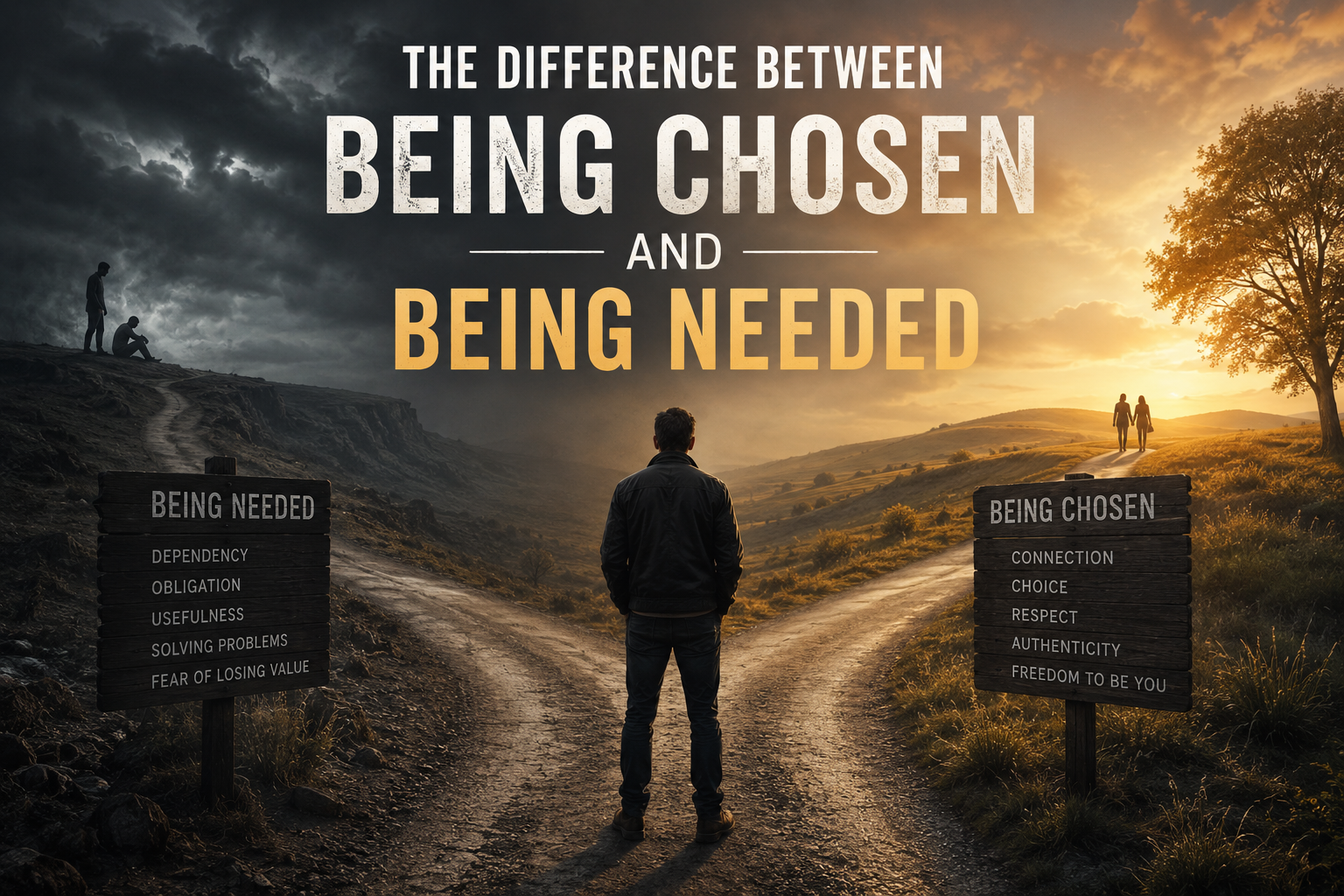
At First, They Feel The Same
Most people cannot immediately tell the difference between being chosen and being needed.
Both can look like attention.
Both can look like commitment.
Both can look like attachment.
Both can create intense emotional bonds.
In the beginning, they often feel identical.
Someone wants your time.
Someone wants your presence.
Someone wants your support.
Someone wants you close.
It feels meaningful.
Important.
Valuable.
And sometimes it is.
But not always.
Because being needed and being chosen are not the same thing.
Not even close.
Being Needed Feels Powerful
There is a certain satisfaction that comes from being needed.
You become important.
Necessary.
Relevant.
Someone depends on you.
They call you when things fall apart.
They seek you when they feel lost.
They rely on you when life becomes difficult.
At first, it feels like love.
Why wouldn’t it?
Your presence matters.
Your absence is noticed.
Your support is appreciated.
But dependency can create an illusion.
An illusion that importance and connection are the same thing.
They aren’t.
Need Often Grows In Crisis
Many relationships become strongest during difficult periods.
Loss.
Stress.
Fear.
Loneliness.
Uncertainty.
People naturally move toward comfort when life becomes painful.
And there is nothing wrong with that.
The problem begins when the relationship only feels strong during hardship.
When your value becomes tied to what you provide.
The advice.
The stability.
The patience.
The reassurance.
The emotional labor.
The relationship survives because you solve problems.
Not because you are genuinely chosen.
The Question Nobody Asks
Most people ask:
“Do they need me?”
Very few ask:
“Would they choose me if they didn’t?”
That question changes everything.
Because choice exists in freedom.
Need exists in dependence.
Choice survives when alternatives exist.
Need often disappears when the problem disappears.
And that difference is enormous.
Being Chosen Looks Different
People who choose you behave differently.
They don’t stay because they have nowhere else to go.
They don’t stay because they need rescuing.
They don’t stay because life is easier.
They stay because they want to.
That sounds simple.
But it changes the entire foundation of the relationship.
You stop feeling responsible for maintaining their emotional stability.
You stop carrying the burden of remaining indispensable.
You stop believing your value comes from what you provide.
Because your value is no longer attached to your function.
It is attached to you.
The Trap Of Becoming Indispensable
Many people unknowingly build relationships around usefulness.
They become:
the fixer
the listener
the rescuer
the caretaker
the stabilizer
the emotional regulator
Over time, the role becomes the relationship.
And that creates a dangerous situation.
Because usefulness can always be replaced.
Roles can always change.
Needs can always evolve.
The relationship becomes vulnerable the moment your function changes.
Not because you changed.
Because the foundation was never built on connection.
It was built on utility.
What Happens When The Need Disappears
This is where many painful realizations begin.
Life improves.
Circumstances change.
The crisis passes.
The instability fades.
And suddenly the relationship feels different.
Not because anyone became a bad person.
Because the original bond was built around a problem.
Once the problem disappears, the relationship has to stand on something else.
Some relationships do.
Some don’t.
And that is often when people discover whether they were loved for who they were or for what they provided.
Healthy Relationships Are Built On Choice
Healthy relationships involve support.
Dependability.
Commitment.
Care.
But underneath all of it sits something stronger.
Choice.
Both people remain because they continue choosing each other.
Not because they are trapped.
Not because they are dependent.
Not because they are afraid.
Not because one person carries the other.
Choice creates freedom.
And freedom creates authenticity.
The relationship becomes voluntary every day.
That makes it stronger.
Not weaker.
Why Choice Feels Different
When someone chooses you, there is less pressure.
Less performance.
Less fear.
Less responsibility for keeping everything together.
You stop feeling like the relationship depends entirely on your usefulness.
You stop feeling like your value must constantly be earned.
You stop wondering whether your role matters more than your presence.
Because your presence becomes enough.
And for many people, that feeling is unfamiliar.
The Difference Between Being Chosen And Being Needed
Being needed feels important.
Being chosen feels secure.
Being needed often depends on circumstance.
Being chosen survives circumstance.
Being needed is tied to function.
Being chosen is tied to connection.
One asks:
“What can you do for me?”
The other asks:
“Who are you when you’re simply yourself?”
Many people spend years chasing the feeling of being needed because it feels significant.
But significance is not the same thing as love.
The healthiest relationships are not built on dependency.
They are built on choice.
And there is a profound difference between someone who stays because they need what you provide…
and someone who stays because, every day, they continue choosing you.
Continue Reading in The Damaged and the Broken:
- Article XVIII: 6-24-26
- Article XVII: The Relationship That Doesn’t Exhaust You
- Article: XVI: The Moment You Stop Explaining Yourself
- Article XV: They Don’t Lean In. They Take It Out On You.
- Article XIV: They Don’t Lean In. They Take It Out On You.
- Article XIII: When Healthy Love Feels Dangerous
- Article XII: They Don’t Slow Things Down. They Reset Control.
- Article XI: You Think It’s Connection. It’s Control.
- Article X: You Think It’s Connection. It’s Control.
- Article IX: It Doesn’t Stay Outside the Relationship
- Article VIII: You Don’t Say What Changed
- Article VII: You Don’t Sit in Uncertainty
- Article VI: Emotional Regulation
- Article V: Projection and Pattern Repetition
- Article IV: The Pursuer–Distancer Cycle
- Article III: The Technically Single Problem
- Article II: Emotional Starvation and the Validation Trap
- Article I: Modern Connection and the Weight We Carry
- The Damaged and the Broken (Overview)

Websites, hosting, email & digital tools for growing brands.