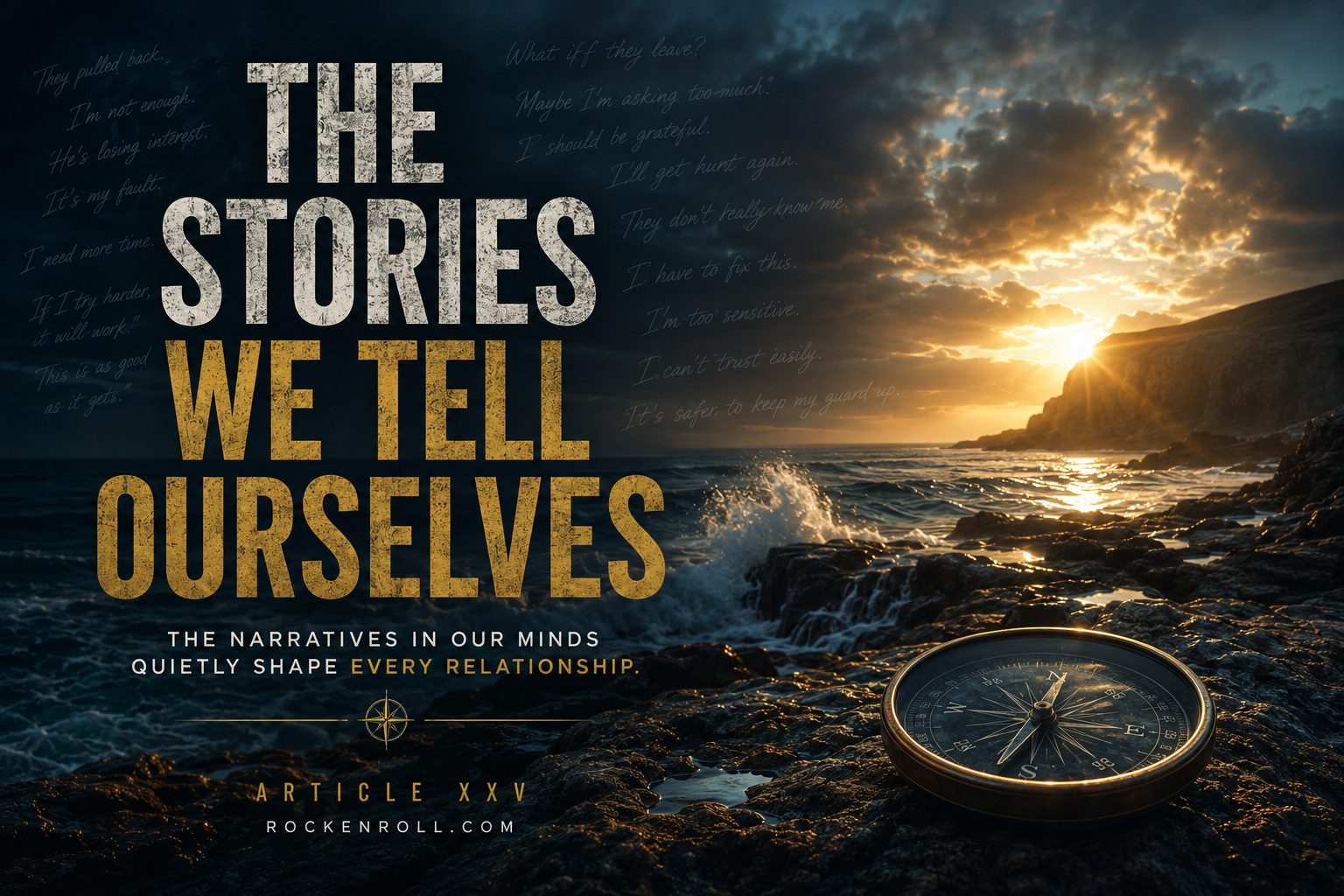
There is a conversation taking place inside every relationship that almost no one hears.
It isn’t spoken aloud.
It isn’t written in text messages.
It isn’t discussed over dinner.
It exists quietly inside each person’s mind.
It is the story they tell themselves.
Sometimes those stories are hopeful.
“This person genuinely cares about me.”
“We can build something meaningful together.”
“We’re on the same team.”
Other times, they are built from fear.
“They’re going to leave.”
“I’m not enough.”
“They’re losing interest.”
“If I get too close, I’ll get hurt.”
Most people believe relationships are shaped primarily by words and actions.
In reality, they are often shaped first by the stories that give those words and actions their meaning.
Two people can witness the exact same moment…
and leave believing completely different things happened.
One partner becomes quiet after a difficult day.
One story says,
“They’re tired.”
Another says,
“They’re pulling away.”
One delayed text message becomes,
“They’re busy.”
Or…
“I’m no longer important.”
A forgotten anniversary becomes,
“They’re overwhelmed.”
Or…
“They never really cared.”
The event rarely creates the damage.
The interpretation does.
Human beings are meaning-making creatures.
Our minds dislike uncertainty.
When information is missing…
we invent it.
Not because we’re dishonest.
Because our brains are designed to complete unfinished patterns.
Unfortunately…
the stories we create often say more about our past than our present.
Someone who has experienced betrayal rarely sees uncertainty as neutral.
Someone who grew up feeling unwanted often hears rejection in ordinary silence.
Someone abandoned by a parent may experience distance long before any actual distance exists.
The relationship didn’t create the story.
It simply became the newest place where the story continued.
The most dangerous stories rarely sound irrational.
They sound protective.
“I’m just being careful.”
“I don’t want to get hurt again.”
“I’m paying attention to the signs.”
“I’m trusting my instincts.”
Sometimes those instincts are valuable.
Sometimes they are old wounds wearing the disguise of wisdom.
The difference is difficult to recognize because both feel equally real.
Once a story takes hold…
something remarkable begins happening.
We unconsciously start collecting evidence that supports it.
Psychologists call this confirmation bias.
We notice the moments that reinforce our belief.
We overlook the moments that contradict it.
If we believe someone is drifting away…
every delayed response becomes proof.
Every distraction becomes confirmation.
Every misunderstanding becomes another chapter.
Meanwhile…
their affection…
their consistency…
their efforts…
quietly disappear into the background because they don’t fit the story we’ve already accepted.
Relationships rarely suffer from facts alone.
They suffer from conclusions.
Conclusions reached before conversations happen.
Conclusions reached without questions.
Conclusions reached because certainty feels safer than uncertainty.
Ironically…
those conclusions often create the very outcome we feared.
Imagine believing someone will eventually leave.
You become cautious.
Less expressive.
More guarded.
You hesitate to trust.
You test their commitment instead of receiving it.
Over time…
they begin feeling shut out.
They pull back.
Not because they planned to leave…
but because the relationship has become exhausting.
When they finally create distance…
the original story feels validated.
“I knew this would happen.”
But the ending wasn’t inevitable.
The story helped write it.
This is one of the quiet tragedies of human psychology.
We often mistake prediction for perception.
We think we’re seeing reality…
when we’re actually watching reality respond to us.
The stories we tell ourselves do not remain private.
They shape our tone.
Our body language.
Our patience.
Our willingness to forgive.
Our curiosity.
Our courage.
Long before another person knows what we’re thinking…
they begin experiencing the behavior created by those thoughts.
There is another kind of story that quietly destroys relationships.
The story of perfection.
“If this relationship were right, it wouldn’t feel this difficult.”
“The right person would automatically understand me.”
“Love shouldn’t require this much work.”
These stories are sold to us everywhere.
Movies.
Social media.
Romantic myths.
They teach us that healthy relationships are effortless.
Reality says something very different.
Healthy relationships require uncomfortable conversations.
Misunderstandings.
Repairs.
Growth.
Adjustment.
Love isn’t measured by the absence of difficulty.
It is measured by what two people choose to do when difficulty arrives.
Some stories sound noble.
“I’m protecting them.”
“I don’t want to burden them.”
“I’ll keep this to myself.”
Yet silence rarely protects intimacy.
It protects misunderstanding.
The other person is left to invent their own story.
Now two people are living inside separate narratives…
both believing they understand the relationship…
while neither is living inside the same one.
Perhaps the healthiest question we can ask ourselves is not,
“Is my story true?”
But…
“What evidence would convince me it isn’t?”
That question creates room for humility.
For curiosity.
For conversations instead of conclusions.
It allows another human being to become who they actually are…
instead of who our fears have already decided they must be.
None of us enters a relationship without stories.
We carry them from childhood.
From heartbreak.
From disappointment.
From extraordinary love.
From betrayal.
From hope.
They become invisible lenses through which we interpret everything another person does.
The goal isn’t to erase those stories.
The goal is to recognize them before they begin writing chapters the other person never intended.
The strongest relationships are not built by people who never create false stories.
They are built by people willing to question them.
People willing to ask…
“Am I reacting to what actually happened…
…or to what I believe it means?”
Those are very different questions.
One seeks understanding.
The other seeks confirmation.
Only one leaves room for love to grow.
Perhaps the greatest danger isn’t that the stories we tell ourselves are completely false.
It is that they are often believable enough to never be challenged.
And once a story goes unchallenged…
it quietly becomes an identity.
Then a habit.
Then a way of living.
Eventually…
a life.
In the end, relationships are shaped by more than the words we speak to one another.
They are shaped by the conversations we never say out loud.
Because the stories we refuse to question…
often become the future we never intended to create.
Continue Reading in The Damaged and the Broken:
- Article XXVI: The Person You Still Believe You Are
- Article XXIV: When Compatibility Still Isn’t Enough
- Article XXIII: When Two People Want Certainty but Both Offer Uncertainty
- Article XXII: The Outer Extremities of Society
- Article XXI: The Relationship You Stop Trying to Win
- Article XX: What Healthy Love Actually Feels Like
- Article XIX: When Peace Starts Feeling Unfamiliar
- Article XVIII: The Difference Between Being Chosen and Being Needed
- Article XVII: The Relationship That Doesn’t Exhaust You
- Article: XVI: The Moment You Stop Explaining Yourself
- Article XV: They Don’t Lean In. They Take It Out On You.
- Article XIV: They Don’t Lean In. They Take It Out On You.
- Article XIII: When Healthy Love Feels Dangerous
- Article XII: They Don’t Slow Things Down. They Reset Control.
- Article XI: You Think It’s Connection. It’s Control.
- Article X: You Think It’s Connection. It’s Control.
- Article IX: It Doesn’t Stay Outside the Relationship
- Article VIII: You Don’t Say What Changed
- Article VII: You Don’t Sit in Uncertainty
- Article VI: Emotional Regulation
- Article V: Projection and Pattern Repetition
- Article IV: The Pursuer–Distancer Cycle
- Article III: The Technically Single Problem
- Article II: Emotional Starvation and the Validation Trap
- Article I: Modern Connection and the Weight We Carry
- The Damaged and the Broken (Overview)

Websites, hosting, email & digital tools for growing brands.