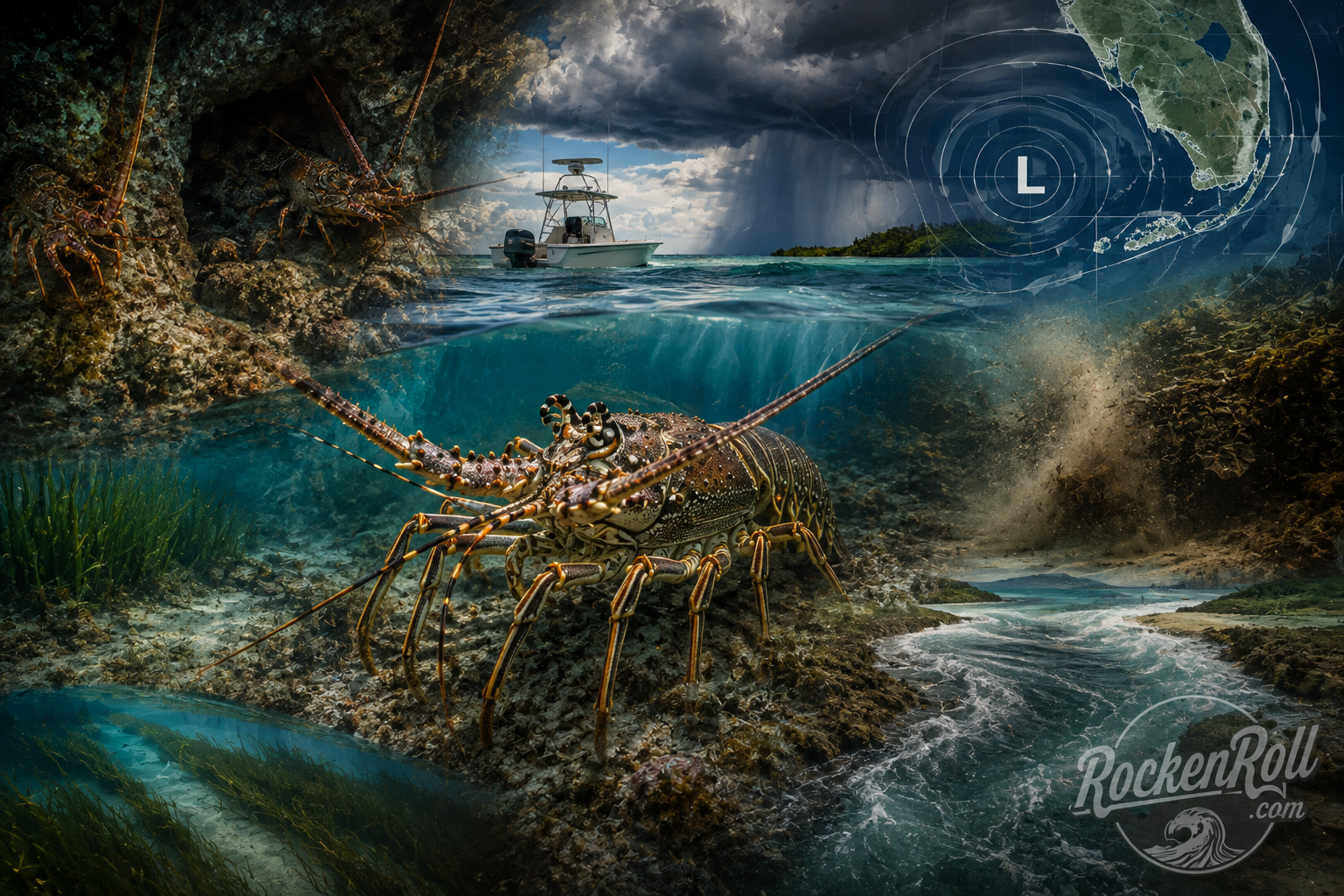
Across the shallow waters of the Lower Florida Keys, Caribbean spiny lobsters (Panulirus argus) occupy an environment that is rarely static.
Tides exchange water between the Gulf of America, Florida Bay and the Atlantic. Wind pushes water across broad shallow flats. Temperatures change rapidly over relatively small depths. Tropical weather can alter currents, wave energy and underwater visibility within hours.
Within that environment, spiny lobsters move.
Some movements are small: an animal leaving its shelter at night to forage and returning before daylight. Others involve movement between nearby shelters or habitats. And under certain environmental conditions, spiny lobsters are capable of organized migrations covering considerable distances.
One of the questions surrounding these movements is whether approaching low-pressure systems play a role.
The evidence suggests an important distinction.
Atmospheric pressure itself may not be the primary driver. The environmental changes accompanying a low-pressure system may be far more important.
A Species Built to Detect Change
The Caribbean spiny lobster is fundamentally different from the clawed lobsters familiar from northern waters.
It possesses no large defensive claws. Instead, it relies heavily on shelter, powerful abdominal muscles, long defensive antennae and an extraordinarily developed sensory system.
Its antennules continuously sample the surrounding water.
Through chemical and mechanical receptors, a lobster can detect substances carried by currents, recognize other lobsters, identify food, respond to predators and evaluate its immediate environment.
This sensory ability is particularly important because much of a lobster’s world is defined by moving water.
A change in current doesn’t simply represent water moving faster. It changes how chemical information travels across the bottom. It can change temperature, suspended sediment, food availability and the physical conditions surrounding a shelter.
For an animal whose survival depends upon interpreting those signals, environmental change matters.
Movement Is a Normal Part of Spiny Lobster Biology
Spiny lobsters are often associated with holes, ledges and coral structure, creating the impression that individual animals permanently occupy small territories.
Research has demonstrated otherwise.
Spiny lobsters routinely leave shelters to forage, change shelters and move between habitats. Larger movements are also documented.
Acoustic telemetry research in the Lower Florida Keys has recorded individuals moving considerable distances. Adult lobsters can move between shallow and deeper habitats, and reproductive behavior can also produce seasonal movements.
The most spectacular example occurs during the well-known autumn migrations.
When environmental conditions change, particularly with falling water temperatures associated with autumn weather, large numbers of spiny lobsters can leave shallow areas and move toward deeper water.
During major migrations, the animals sometimes form single-file queues extending across the seafloor.
Each lobster maintains physical contact with the animal ahead using its antennae.
These migrations demonstrate that Panulirus argus is capable of coordinated movement when environmental conditions cross certain thresholds.
The Question of Atmospheric Pressure
Fishermen and divers have long associated changing animal behavior with falling barometric pressure.
The idea is plausible because changes in atmospheric pressure are transmitted into the ocean.
But determining whether a lobster is responding directly to atmospheric pressure is difficult because pressure rarely changes in isolation.
An approaching low-pressure system simultaneously changes numerous environmental variables.
Wind strengthens.
Wind direction changes.
Wave energy increases.
Currents can change.
Water levels fluctuate.
Sediment becomes suspended.
Visibility decreases.
Temperature can change.
Water from neighboring environments can be transported across the shallow shelf.
Consequently, observing lobster movement during falling pressure does not demonstrate that pressure itself caused the movement.
The lobster may instead be responding to the transformation of its underwater environment.
What Happens Beneath a Low-Pressure System
The Lower Keys are particularly susceptible to weather-driven changes because so much surrounding habitat is shallow.
Wind blowing continuously across shallow water transfers energy into the water column.
As winds increase, waves become larger and bottom turbulence increases. In sufficiently shallow areas, wave energy reaches the seafloor.
Sediment can be resuspended.
Seagrass moves violently.
Loose material is transported.
Visibility can collapse.
Water may be pushed toward or away from shore depending upon wind direction.
Currents through passages between islands can strengthen or change direction.
A diver entering the water before and after such an event may effectively encounter two very different underwater environments even though the physical reef or hard-bottom structure has not changed.
For a lobster living beneath a small ledge or within scattered hard bottom, those changes can alter whether a particular shelter remains desirable.
Storms Demonstrate the Scale of Underwater Disturbance
Tropical cyclones provide the extreme example.
Research following hurricanes in the Florida Keys has documented substantial displacement of commercial lobster traps. Heavy traps can be dragged, overturned or transported by storm-generated currents and waves.
That provides a useful measure of the forces operating near the seafloor.
A lobster is considerably more mobile than a trap.
It can leave exposed habitat, seek deeper shelter or relocate entirely.
This does not mean every approaching low-pressure system initiates migration. Most do not.
It demonstrates that weather occurring above the surface can profoundly alter conditions on the bottom.
The Importance of Temperature
Among the environmental variables associated with lobster migration, temperature has considerably stronger scientific support than atmospheric pressure alone.
The famous Florida lobster migrations have long been associated with rapid decreases in water temperature.
Laboratory and field observations indicate that declining temperature can increase locomotor activity and contribute to migratory behavior.
This becomes particularly important when cold fronts move through South Florida during autumn.
Shallow water loses heat faster than deeper offshore water. A strong frontal passage can therefore create a relatively abrupt thermal change across shallow lobster habitat.
For an ectothermic animal whose body temperature is controlled by its surroundings, that change is biologically significant.
The resulting migration toward deeper water is not random wandering. It represents movement toward a more stable environment.
Summer Low Pressure Is Different
Low-pressure systems during Florida’s summer lobster season generally do not produce the dramatic temperature declines associated with autumn cold fronts.
That distinction is important.
An August tropical disturbance should not automatically be expected to produce the classic mass migration seen later in the year.
Instead, summer weather may produce localized redistribution.
Animals may leave exposed shelters.
They may move from shallow hard bottom toward more protected structure.
They may travel along deeper edges.
They may relocate after heavy wave action alters their previous shelter.
The movement could involve hundreds of yards rather than miles.
From the lobster’s perspective, that may be relatively minor.
From a diver’s perspective, it can completely change what is found in a particular area.
Channels Connect the Lower Keys
The geography of the Lower Keys makes this movement particularly interesting.
The islands do not form a continuous barrier.
They are separated by channels and passages through which enormous quantities of water move between Gulf-side and Atlantic-side environments.
These passages connect seagrass beds, hard-bottom habitat, mangrove shorelines, shallow banks and deeper water.
They therefore function as biological corridors as well as tidal channels.
Marine organisms move through them.
Larvae are transported through them.
Predators forage along them.
And adult animals can use them while moving between habitats.
For spiny lobsters, this interconnected landscape means an animal does not necessarily need to undertake a spectacular migration to appear somewhere completely different.
Relatively short movements through connected habitat can redistribute animals across a surprisingly large area.
Why Large Lobsters May Suddenly Appear
One of the more interesting observations reported by divers is the sudden appearance of unusually large lobsters without a corresponding explosion in overall lobster numbers.
That observation deserves distinction from mass migration.
Large adult lobsters generally occupy different ecological roles and ranges than juveniles. Adults are more capable of traveling substantial distances and using deeper habitat.
If environmental conditions cause adults to redistribute themselves, a diver might encounter fewer animals overall while seeing a greater proportion of large individuals.
The population did not suddenly increase.
The distribution changed.
This distinction is fundamental when interpreting what divers observe underwater.
A productive location does not necessarily indicate a locally increasing lobster population, just as an empty location does not necessarily mean lobsters disappeared from the region.
Animals can simply move beyond the small portion of habitat being observed.
Current May Be as Important as Weather
The Lower Keys exist within an unusually dynamic hydrological environment.
Tidal currents move through narrow channels. Wind can reinforce or oppose those currents. Offshore circulation influences surrounding water masses. Local bathymetry concentrates flow through particular passages.
For lobsters, current determines much more than direction of travel.
It transports chemical information.
It carries food.
It changes sediment conditions.
It influences temperature.
It affects the energetic cost of moving across the bottom.
It also connects one habitat with another.
A falling barometer accompanied by a major wind shift may therefore create an entirely different current regime from falling pressure under relatively calm conditions.
The biological response could consequently be very different.
Migration Versus Redistribution
This distinction may be the most important when discussing lobster movement in the Lower Keys.
Migration describes directed movement between regions or habitats, often associated with seasonal or environmental triggers.
Redistribution can occur on a much smaller scale.
A lobster moving several hundred yards from scattered hard bottom into a protected channel edge has not necessarily begun a major migration.
Yet to a diver returning to the same collection of holes, the effect can appear dramatic.
Yesterday the holes were empty.
Today several contain lobsters.
Nothing appeared from nowhere.
The animals moved.
What Science Can and Cannot Say
There is strong evidence that Caribbean spiny lobsters respond to environmental conditions.
There is strong evidence that they move between habitats.
There is strong evidence connecting temperature changes with major migratory behavior.
There is also extensive evidence that storms can dramatically alter the shallow marine environment of the Florida Keys.
What is much harder to establish is the simple claim:
Falling atmospheric pressure causes Florida spiny lobsters to migrate.
There are too many variables changing simultaneously to make that statement confidently.
Pressure may contribute.
It may act as an environmental cue.
Or it may simply coincide with the wind, temperature, wave and current changes that actually stimulate movement.
Separating those mechanisms requires controlled research rather than observation alone.
An Animal Living in a Moving Landscape
From above the surface, the Lower Keys appear remarkably permanent.
The islands remain in place. Channels follow familiar routes. Seagrass flats stretch toward the horizon.
Underwater, the environment is considerably more dynamic.
Water masses move back and forth.
Temperature boundaries shift.
Currents accelerate and reverse.
Sediment moves.
Storms alter habitat.
Chemical signals travel through the water.
And the animals inhabiting that landscape respond.
The Caribbean spiny lobster is particularly well adapted to that world.
Its movements are not simply random journeys from one hole to another. They are part of a behavioral system shaped by shelter, predators, reproduction, temperature, currents and changing environmental conditions.
Low-pressure systems are one component of that environment.
Whether lobsters can directly anticipate an approaching low remains a more difficult scientific question.
But there is little doubt about what happens when that weather begins transforming the sea around them.
**The environment changes.
And sometimes, the lobsters move with it.**
August 2026: What to Watch Next
As of August 9, 2026, there is no significant low-pressure system forecast to directly affect the Lower Florida Keys during the immediate seven-day period. The National Hurricane Center is monitoring tropical activity farther east in the Atlantic, but none of those systems currently poses a direct threat to the Keys.
That makes the remainder of August an interesting period for observation.
If a tropical disturbance or organized low-pressure system eventually approaches the Gulf of America or Florida Straits, conditions before and after its passage could provide an opportunity to observe whether lobster distribution changes as the surrounding environment changes.
The important variables would not be atmospheric pressure alone. Wind direction and duration, wave energy, tidal flow, current strength, water temperature, turbidity and bottom disturbance should all be considered.
Then comes the most important observation:
Where were the lobsters before the weather changed and where were they afterward?
A noticeable increase in lobsters occupying channels, deeper edges or protected structure following a weather event would not prove that low pressure caused the movement. But repeated observations under similar conditions could reveal patterns worth documenting.
For now, August 2026 provides a useful baseline: relatively stable conditions in the Lower Keys, with tropical activity developing farther out in the Atlantic.
If that changes, so may the water.
And that is when the lobsters become particularly interesting to watch.
Weather reference: National Weather Service Key West and National Hurricane Center tropical outlooks, August 9, 2026.

Websites, hosting, email & digital tools for growing brands.
Comments