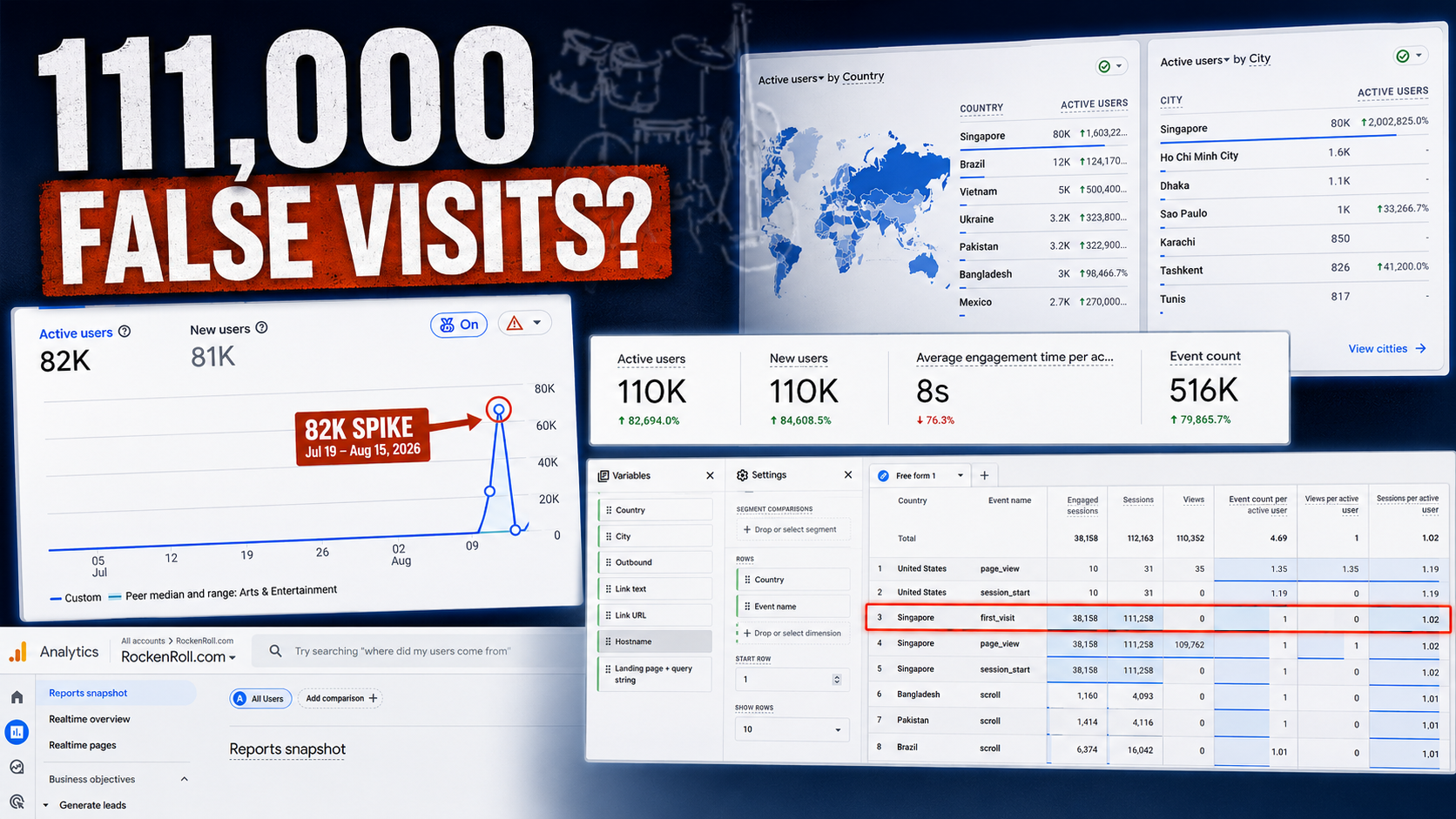
On August 10, 2026, Google Analytics reported an extraordinary surge in activity on RockenRoll.com. Traffic attributed to Singapore went from virtually nothing to approximately 111,000 sessions.
The numbers initially looked exciting. A closer examination showed something different: nearly one session per view, abnormally low engagement, events disconnected from normal landing pages, and activity involving unrelated or nonexistent URLs. This was not a sudden wave of musicians discovering RockenRoll.com. It was manufactured or automated traffic.
The important question is who generated it and whether “Singapore” identifies the operator or merely the infrastructure used to conceal the operator.
Google Analytics determines a visitor’s country primarily from the IP address associated with the activity. An IP address located in Singapore does not prove that the person controlling it was physically in Singapore. The operator could have used a Singapore-based proxy, VPN exit point, cloud server or compromised machine while operating from almost anywhere.
A proxy acts as an intermediary. Instead of connecting directly to RockenRoll.com, an operator sends activity through another computer. RockenRoll.com and Google Analytics see the intermediary’s IP address in this case, apparently Singapore rather than the operator’s actual location.
Residential proxy networks make identification even more difficult. They route activity through ordinary internet-connected devices so automated traffic appears to come from a normal household or business connection. Cloudflare explains that attackers use residential proxies to masquerade as legitimate users, and that commercial proxy providers advertise access to pools containing tens of millions of residential and mobile IP addresses. Cloudflare’s residential-proxy analysis.
In July 2026, Google and the FBI disrupted the NetNut residential proxy network after it was allegedly used to conceal and route malicious activity. According to reporting on the operation, the disruption reduced the proxy network’s available device pool by millions. This provides current evidence that large proxy services are being used to hide the true origin of automated and potentially criminal internet activity. Reuters report on the NetNut disruption.
That does not prove RockenRoll.com’s traffic came through NetNut or any other particular proxy. It establishes that the method is real, widely available and actively exploited.
The Singapore identification is therefore meaningful but incomplete. It tells us where the visible infrastructure appeared to be located. It does not tell us who rented, controlled or ordered it.
Singapore is an authoritarian-leaning, one-party-dominant capitalist state. It is also a sophisticated international center for finance, software, telecommunications and cloud computing. Its government-directed development model has produced extensive digital infrastructure, strong international connectivity and a highly skilled technology sector.
I had previously heard almost entirely positive things about Singapore. I also know an accomplished Malaysian software professional who recently completed a two-month work assignment there. She is intelligent, focused, highly driven and successful in her career. On a personal level, she is also a strikingly attractive woman. Her combination of ability, discipline, ambition and presence reflects the caliber of professionals participating in the region’s legitimate technology economy.
Her example is an important reminder that a suspicious IP location should never be used to characterize an entire population. The conduct of an unidentified operator does not diminish the accomplishments or integrity of the many legitimate professionals who live and work in Singapore.
That reality can coexist with a harder question: when Singapore-based digital infrastructure is used for suspicious international activity, who is responsible for identifying the customer behind it?
The operator may not be Singaporean at all. A foreign individual or company can rent computing resources in Singapore precisely because the country is a major regional technology hub. A traffic-generation service can route automated browsers through Singapore proxies. A scraper can conceal its true location. A criminal group can use several layers of rented or compromised infrastructure.
Possible objectives include testing automated browser systems, collecting public data, scanning WordPress websites for vulnerabilities, selling fraudulent “website visitors,” manipulating analytics or validating a proxy network.
The financial and legal risk may appear small to the operator. Automated traffic is inexpensive, thousands of websites can be targeted simultaneously, and the visible IP address may lead only to a hosting or proxy provider. Identifying the customer behind that address may require cooperation from the provider and potentially legal process across national borders.
Government involvement is one possibility, but it is not established by the available evidence. Other possibilities include a private Singapore company, a foreign customer using Singapore infrastructure, a government contractor, a traffic-fraud service, a scraper or an independent criminal operator.
Has This Happened to Other Websites?
Yes. RockenRoll.com is not the only website to report suspicious analytics or bot activity attributed to Singapore.
A February 2026 Google Analytics support discussion described GA4 properties receiving sudden direct traffic from China and Singapore, with missing or abnormal landing-page information. Google Analytics support discussion.
A separate public report described two managed GA4 accounts experiencing major direct-traffic spikes from Singapore. Engagement lasted less than three seconds, and the traffic disappeared after approximately 15 to 20 days. Google Analytics community report.
In April 2026, a Shopify website owner reported what appeared to be coordinated bot activity from Singapore. Shopify community report.
A December 2025 analysis also documented a broader wave of GA4 bot traffic attributed to China and Singapore that bypassed normal bot filtering and distorted website reporting. Analysis of the China–Singapore GA4 bot wave.
These sources provide at least four distinct published reports or analyses, including one report involving two separate client websites. They establish a recurring pattern, but they do not provide a reliable worldwide incident total.
There is no central registry counting every case of Singapore-attributed analytics spam. Most website owners never report it publicly, and one automated campaign may affect thousands of domains while appearing as a separate incident to every owner.
One security study provides a clearer measurement of the scale of malicious network activity. During a 30-day period in 2023, GreyNoise observed 7,849 malicious exploitation attempts originating from IP space attributed to Singapore and directed toward networks in other countries. During the same period, Singapore itself received more than 206,000 malicious attempts from outside networks. GreyNoise Singapore threat analysis.
Those figures are counts of observed attempts, not identified operators or criminal cases. They demonstrate two important facts: suspicious traffic regularly appears to originate from Singapore, and Singapore is also heavily targeted by outside attackers. Infrastructure in the country can function as both a target and an apparent source.
What the Evidence Shows
There is evidence that:
- Proxy networks are routinely used to conceal automated and malicious traffic.
- Multiple website owners have reported abnormal GA4 traffic attributed to Singapore.
- Security researchers have observed thousands of malicious attempts originating from Singapore-attributed IP space.
- Singapore contains extensive cloud and international network infrastructure capable of supporting high-volume automation.
What Has Not Been Established
There is not yet evidence that:
- RockenRoll.com’s traffic specifically used a proxy.
- The operator was physically located in Singapore.
- The operator was a Singaporean citizen or company.
- The Singaporean government ordered or knowingly permitted the activity.
- All reported Singapore incidents came from the same operator.
The source IP addresses are therefore essential. RockenRoll.com’s firewall and server logs can identify the network owner, known as the autonomous system or ASN. That information may show whether the traffic came from a commercial cloud provider, proxy company, residential network, state-linked organization or another source.
If the hosting logs show no corresponding requests, the apparent visits may have been fabricated and sent directly into Google Analytics. In that situation, even the Singapore location could have been supplied or produced as part of the false event data.
If the requests did reach the server, the IP ownership, user-agent strings, requested URLs, timing and firewall actions could begin identifying the infrastructure and purpose behind the campaign.
The responsible conclusion is not that the people of Singapore generated 111,000 false visits. The evidence shows that suspicious activity presented itself through an IP location attributed to Singapore.
Singapore’s success as a tightly governed global digital hub creates the relevant connection: it has built infrastructure powerful and accessible enough to attract legitimate international business, while that same infrastructure can potentially be rented or exploited by operators seeking speed, scale and anonymity.
The remaining questions are legitimate and important: Who controlled the proxy or server? Who paid for it? What information did the provider collect about its customer? Did the traffic reach the website, or was it injected directly into Google Analytics? What mechanisms exist in Singapore for reporting and investigating abuse originating from infrastructure located there?
Until the underlying network records are obtained, Singapore is the visible point of origin, not the proven identity of the perpetrator.
Safety Measures and Continued Monitoring
RockenRoll.com is protected through JoeUSA.com with a web application firewall, DDoS protection, SSL encryption, daily security scanning, secure backups and a global content-delivery network. These safeguards help maintain reliable performance and protect legitimate visitors.
Traffic patterns, analytics and website performance remain under active monitoring. Additional controls can be applied if the source or pattern of the unusual automated activity is identified. The activity discussed in this article affected analytics reporting, while RockenRoll.com continues operating normally for its members and visitors.

Websites, hosting, email & digital tools for growing brands.
Comments