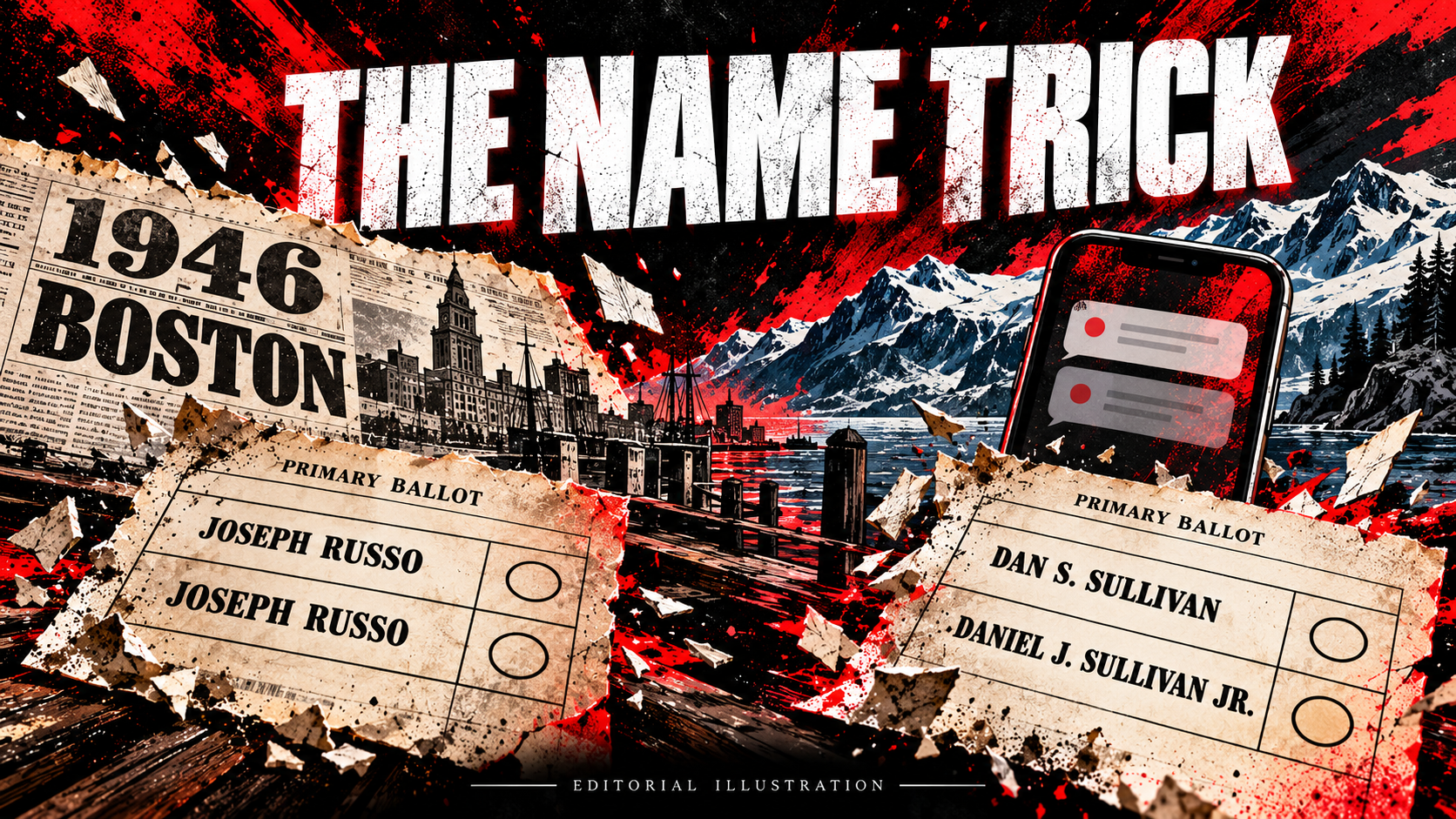
How do political operatives convince themselves that recruiting someone with an opponent’s name is an acceptable way to win an election?
And how, in an age of screenshots, searchable records and instantly shareable messages, do they imagine the operation will remain hidden?
The allegations surrounding Alaska’s 2026 Senate race raise both questions. They also expose a deeper problem: a political mentality that treats voter confusion as something a campaign can manufacture for its own advantage.
For the Democratic operatives implicated in the reporting, the question is whether winning became sufficient justification for deliberately making the ballot harder to understand.
Searching for a name instead of an argument
According to Associated Press coverage of an October 28 New York Times investigation, messages between members of Mary Peltola’s campaign discussed recruiting another person named Dan Sullivan to run against Republican Sen. Dan Sullivan. A retired teacher from Petersburg, Dan J. Sullivan, ultimately entered the race and advanced to the general election.
Peltola’s campaign denies involvement with either Sullivan campaign. The Democratic Senatorial Campaign Committee also denies involvement, and the second Sullivan has denied running at Democrats’ direction. Those denials belong in the record alongside the allegations. But the AP’s account says the Times obtained messages discussing namesake recruitment, making this more substantial than suspicion based on a shared surname.
The ethical distinction is straightforward. A citizen has every right to challenge a senator. Recruiting that citizen because voters might mistake him for the senator serves an entirely different purpose.
It turns someone else’s mistaken identification into a campaign asset.
That is the cheating mentality at the center of this controversy: seeking an advantage from votes that may fail to reflect the voter’s actual intention. Whether particular conduct violates a law requires its own evidence and legal judgment. The contempt for informed choice is the issue here.
An old Kennedy maneuver
The historical comparison reaches back to John F. Kennedy’s first congressional campaign in 1946.
As Brookings recounts, Kennedy faced Boston City Councilor Joe Russo in the Democratic primary. Kennedy’s father allegedly paid another Joseph Russo, a custodian without political experience, to enter the contest in hopes of dividing the opposition vote.
The value of the additional candidate lay in his name. The intended advantage depended on voters misunderstanding whom they were supporting.
The comparison does not prove an unbroken conspiracy stretching across eight decades. It does show how readily the same cynical idea can reappear: when an opponent has earned name recognition, find someone who can borrow it on the ballot.
How could anyone expect this to stay hidden?
Technology makes the apparent calculation especially revealing.
Digital voter records can make a namesake easier to locate. Electronic communication makes an operation easier to organize. Those same tools create opportunities for exposure. A message can be retained, forwarded or photographed. Participants can leave a campaign and speak to reporters.
In this case, messages and a former campaign manager’s account reportedly helped bring the recruitment effort into public view.
So why take the risk?
One possible explanation is that secrecy was never the only calculation. Operatives may believe exposure can be managed: deny coordination, dispute responsibility and let the election calendar keep moving. That is an inference about incentives, rather than an established account of what these individuals thought.
But it points to the more troubling possibility. Someone contemplating this tactic might expect to survive being caught.
The ballot cannot be an instrument of deception
Alaska’s ranked-choice system complicates the scheme’s potential effect. If a voter ranks the second Sullivan first and the incumbent second, that ballot can transfer to the incumbent when the first candidate is eliminated. A vote for the namesake therefore does not automatically become a lost vote for the senator.
That limits claims about the electoral damage. It does nothing to excuse a deliberate attempt to create confusion.
Democratic leaders should answer the reported evidence directly. Who proposed namesake recruitment? Who approved it? Who participated? What consequences follow if the allegations are substantiated?
A party asking voters to trust its defense of democratic institutions should hold its own operatives accountable when their methods undermine informed voting.
The central question is bigger than whether a second Dan Sullivan changes the result. It is whether the people seeking power respect voters enough to let them make a clear choice.
Technology can expose a dirty trick. Accountability determines whether the next campaign decides it is worth trying again.

Websites, hosting, email & digital tools for growing brands.