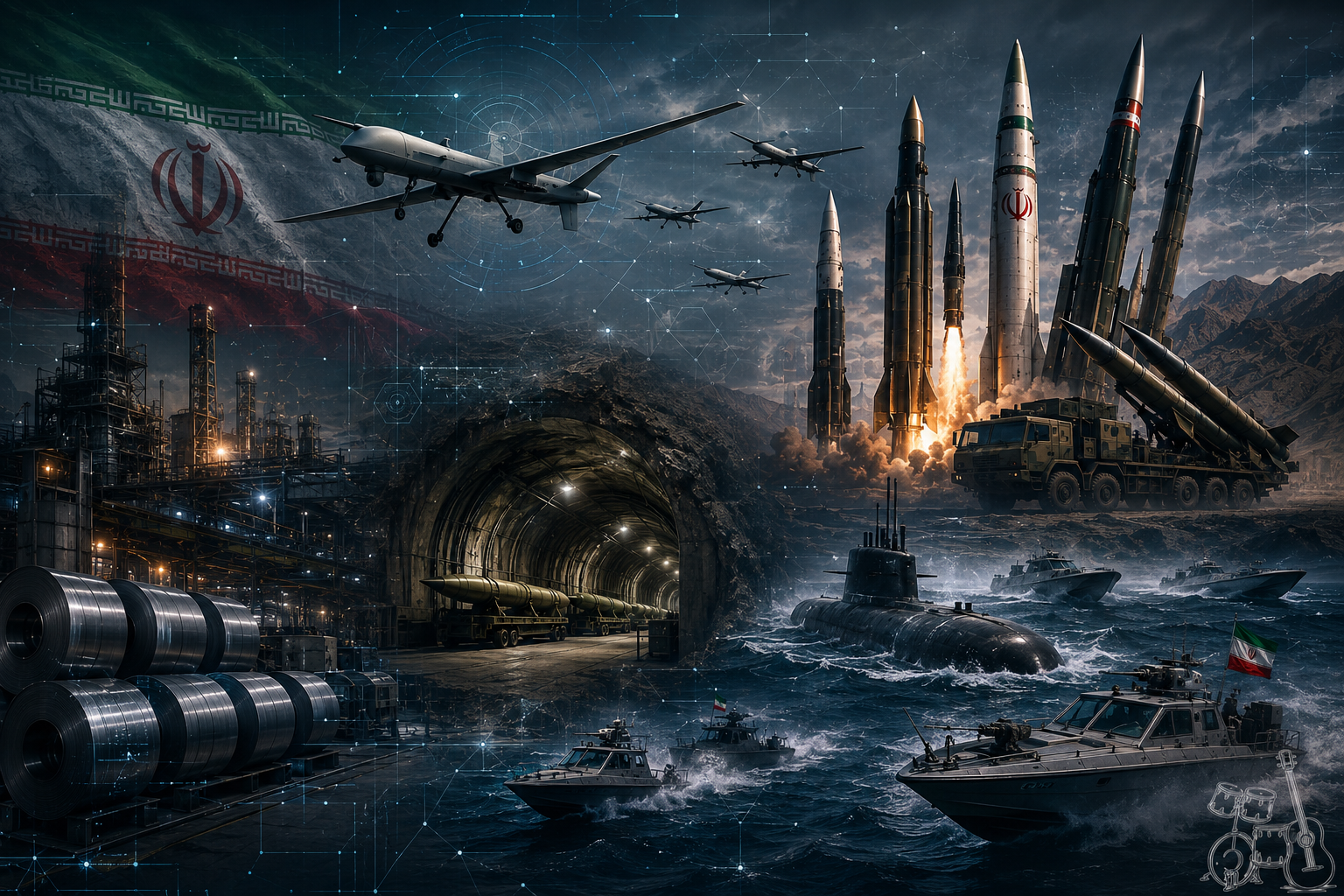
Iran maintains arms through domestic manufacturing of missiles, drones, and other systems. It has produced its own tanks, armored personnel carriers, missiles, radars, boats, submarines, unmanned aerial vehicles, and fighter plane components since 1993.
Russia supplied major arms to Iran in the past decade. China supplied materials and dual-use technologies. North Korea supplied missile-related technology.
Strikes targeted Iranian missile and drone production sites, including Khojir, Shahroud, Parchin, and Hakimiyeh facilities. Strikes hit approximately 70 percent of Iran’s defense industry targets according to one assessment. Strikes damaged steel production facilities critical for missile production. Iran ceased operations at its main steel production facility in Esfahan Province.
U.S. intelligence assessed that approximately 50 percent of Iranian missile launchers remained intact as of April 2026. Iran retained roughly 60-70 percent of its prewar missile stockpile and 40 percent of its drones according to assessments from April-May 2026.
Iran produced Shahed-class drones. Prewar production capacity estimates reached 10,000 per month. Iran launched more than 500 ballistic missiles and over 2,000 drones in responses during earlier operations.
Underground facilities and tunnel entrances were struck. 77 percent of visible tunnel entrances were hit according to one analysis. Activity at some sites resumed after repairs to entrances. Iran regained access to roughly 90 percent of its underground missile storage and launch facilities by May 2026, assessed as partially or fully operational.
Iran supplies weapons, training, and components to groups including Hezbollah, Houthis, and Iraqi militias. Large shipments of munitions to Houthis, including drone parts and missile components, were intercepted.
Reconstitution timelines for munitions vary. Assessments indicate 1 to 4 years to rebuild certain stockpiles to prewar levels under continued pressure. Iran restarted some drone production during a ceasefire period that began in early April 2026.
Current Sources of Firepower as of July 2026
As of July 18, 2026, Iran retained around 2,000 medium-range missiles. Iran maintained large numbers of short-range missiles, armed drones, and anti-ship capabilities.
Iran fired high-speed, maneuverable ballistic missiles, including Haj Qassem variants, at U.S. bases in the region on July 18. Iranian forces launched missiles targeting U.S. facilities in Jordan, Bahrain, and other Gulf locations in July 2026.
Iran conducted missile and drone attacks in response to U.S. strikes, including operations against bases in Jordan (killing two U.S. service members on July 17), Bahrain, Kuwait, and Saudi Arabia.
Remaining operational launchers, repaired underground facilities, and resumed production of drones and simpler missiles supplied current munitions. Domestic manufacturing continued at surviving and improvised facilities. Proxy support and component smuggling networks provided additional materials.
Current Supply Status
Iran’s current supply consists of remaining prewar stockpiles (estimated at thousands of missiles and drones as of mid-2026), ongoing domestic production of Shahed-class drones and short-range missiles at surviving facilities, repaired access to underground storage sites, and limited component inflows through smuggling and external suppliers. These enable continued launches of ballistic missiles and drones in July 2026. No assessments indicate complete depletion.
Depletion Outlook
No public assessments state a precise date when Iran will be entirely out of arms. As of July 20, 2026, Iran continues to conduct missile and drone attacks, indicating it retains operational munitions.
These facts are based on public assessments available as of July 20, 2026.

Websites, hosting, email & digital tools for growing brands.