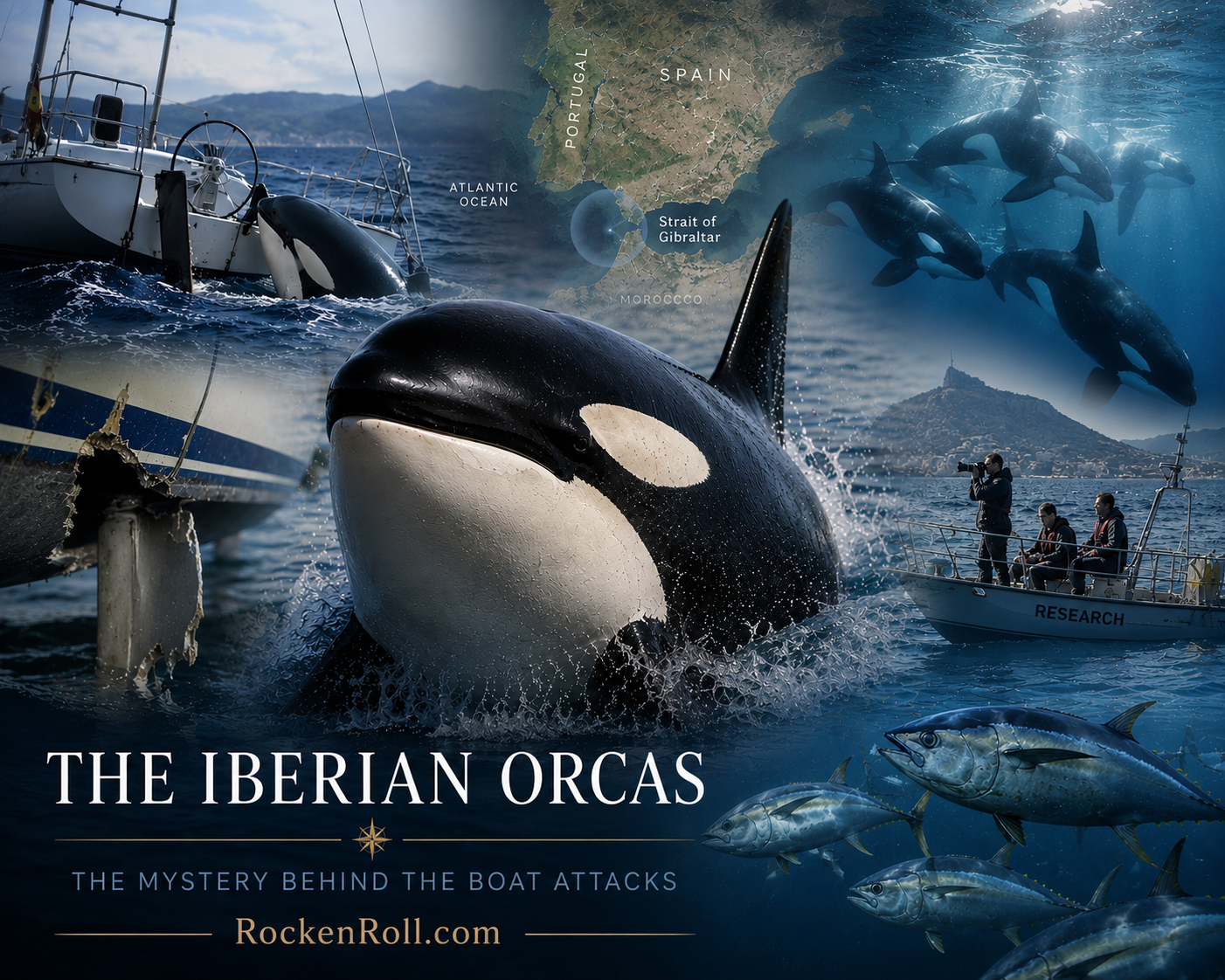
What We Know, What We Don’t Know, and What Happens Next
Since July 2020, one of the world’s rarest killer whale populations has been responsible for one of the most unusual wildlife phenomena ever documented.
A small group of Iberian orcas has repeatedly targeted sailboats along the coasts of Spain, Portugal, and occasionally Morocco. What began as an isolated incident has evolved into more than 700 documented interactions, damaging hundreds of vessels and sinking several yachts. Yet despite the headlines, there has never been a documented case of these orcas intentionally attacking a human in the water.
The question remains:
Why?
After six years, scientists still cannot answer it with certainty.
The Population
This is not the global orca population.
These are Iberian orcas, a genetically distinct, critically endangered population that inhabits the Strait of Gibraltar and nearby Atlantic waters.
Characteristics include:
- Fewer than 50 animals remain.
- They specialize in hunting Atlantic bluefin tuna.
- They possess unique vocal dialects.
- They rarely mix with other orca populations.
- Every adult is considered extremely valuable to the survival of the population.
Only a fraction of these whales appear involved in the boat interactions.
Researchers estimate roughly 15 identified individuals participate regularly.
Timeline
Before 2020
No widespread pattern of deliberate rudder attacks had been documented.
Occasional curiosity toward vessels occurred as happens with many marine mammals but nothing resembling today’s behavior.
July 2020
Everything changed.
Reports began arriving of orcas striking sailboats.
Not random collisions.
Not feeding.
Not defensive displays.
They specifically targeted rudders.
2021–2023
Interactions increased dramatically.
Patterns emerged:
- approach from behind
- target rudder
- push
- bite
- twist
- disable steering
Often, once the rudder failed, the orcas simply left.
2024–2026
The behavior expanded geographically.
Originally concentrated near Gibraltar, reports gradually spread northward along Portugal and into Galicia.
Several yachts ultimately sank after rudder damage caused water intrusion.
Authorities now issue seasonal navigation advisories.
Why the Rudder?
This may be the biggest clue.
The whales rarely attack:
- hulls
- masts
- propellers
- sails
Instead they focus almost exclusively on the steering system.
That suggests intentional targeting rather than generalized aggression.
No one knows why.
Major Theories
1. Trauma Theory
Probably the best-known explanation.
Researchers believe one female commonly called White Gladis, may have experienced a traumatic interaction involving a vessel around 2020.
Possible events include:
- collision
- entanglement
- propeller strike
- fishing gear
No one witnessed such an event.
No evidence proves it occurred.
The idea is based largely on timing and subsequent observations.
2. Social Learning
Orcas possess one of the most advanced cultures in the animal kingdom.
Young whales learn:
- hunting methods
- communication
- migration
- traditions
from older whales.
Researchers suggest younger Iberian orcas copied the original behavior.
Evidence supporting this:
- juveniles participate frequently
- not every orca population performs identical behaviors
- other culturally learned behaviors exist throughout the world
Examples include:
- intentional beaching to catch seals in Patagonia
- shark liver specialization in New Zealand
- “salmon hat” behavior observed in the Pacific Northwest
The weakness?
Social learning may explain how the behavior spread.
It does not explain why it began.
3. Play Theory
Perhaps the most controversial explanation.
Some scientists believe the whales discovered that rudders:
- move unpredictably
- push back
- vibrate
- break loose
making them interesting objects to manipulate.
Supporters note underwater videos often show behavior that lacks obvious aggression.
Critics point out:
If this is merely play;
Why only here?
Why for six years?
Why target expensive vessels instead of countless other floating objects?
Those are fair scientific questions, and they remain unanswered.
4. Revenge Theory
Popular online.
Little scientific support.
The idea suggests the whales are intentionally retaliating against humans.
There is no evidence of coordinated revenge.
Nor has any whale attempted to attack people after disabling boats.
Most researchers consider this unlikely.
5. Environmental Stress
Another possibility.
Researchers have examined:
- pollution
- contaminants
- prey availability
- fishing pressure
- underwater noise
- ecosystem changes
Could chronic stress alter behavior?
Possibly.
Has any specific environmental factor been linked directly to the attacks?
No.
At least not yet.
6. Fishing Gear Association
Some researchers wonder whether rudders resemble fishing equipment.
These whales spend much of their lives around tuna fisheries.
Could rudders have become associated with competition or negative experiences?
Possible.
Evidence remains circumstantial.
Could Something Still Be Missing?
Absolutely.
One criticism often raised even among experienced observers is that current theories may be incomplete.
Several questions remain unresolved:
Why only this population?
Why only sailboats?
Why rudders?
Why has the behavior persisted?
Why has it expanded geographically?
Scientists openly acknowledge these unknowns.
Why Don’t Orcas Everywhere Do This?
Perhaps the strongest argument against simple “play.”
Orcas exist worldwide.
Many populations interact with boats daily.
None display this same persistent pattern.
Researchers respond that orca cultures differ dramatically between populations.
That is true.
But it still leaves unanswered why this particular cultural behavior emerged only here.
The origin remains unknown.
What Boats Are Targeted?
Data show clear preferences.
Most interactions involve:
- monohull sailboats
- catamarans
- spade rudders
Motorboats represent only a small percentage of reports.
What Should Sailors Do?
Spanish and Portuguese authorities recommend:
- stop the vessel
- remove pressure from the rudder
- avoid attempting to outrun the whales
- contact maritime authorities if necessary
- avoid dangerous interaction zones during peak seasons
Interestingly, reports show mixed success.
Some boats stopping experienced less severe damage.
Others suffered significant damage regardless.
No universally effective strategy exists yet.
Is the Population Growing?
Very slowly if at all.
Despite the attention they receive, Iberian orcas remain critically endangered. Recent assessments suggest the total population is still under 50 animals, with births roughly balancing losses in some years but mature female survival and reproductive success remain concerns. This is not a rapidly expanding population.
What Is Being Done?
Scientists continue to:
- photograph every known individual
- collect DNA samples
- monitor movements
- analyze underwater recordings
- document every interaction
- map seasonal hotspots
- compare successful and unsuccessful avoidance methods
- educate sailors about high-risk areas and recommended responses.
Authorities have also expanded seasonal advisories as the interaction zone has shifted northward in recent years.
The Bottom Line
After six years, the Iberian orca phenomenon remains one of marine biology’s most intriguing unsolved mysteries.
Researchers have identified patterns, but they have not identified a definitive cause.
The evidence currently supports several conclusions:
- A relatively small subset of the Iberian orca population is responsible for most interactions.
- The whales overwhelmingly target rudders rather than people.
- Social learning likely explains how the behavior spread among participating whales.
- The original trigger for the behavior remains unknown.
- Environmental factors, traumatic events, and ecological pressures have all been investigated, but none has been confirmed as the primary cause.
In other words, science has made substantial progress in describing what these orcas do and how the behavior is maintained but the question that captures the public’s imagination, why it started in the first place, is still unanswered.

Websites, hosting, email & digital tools for growing brands.