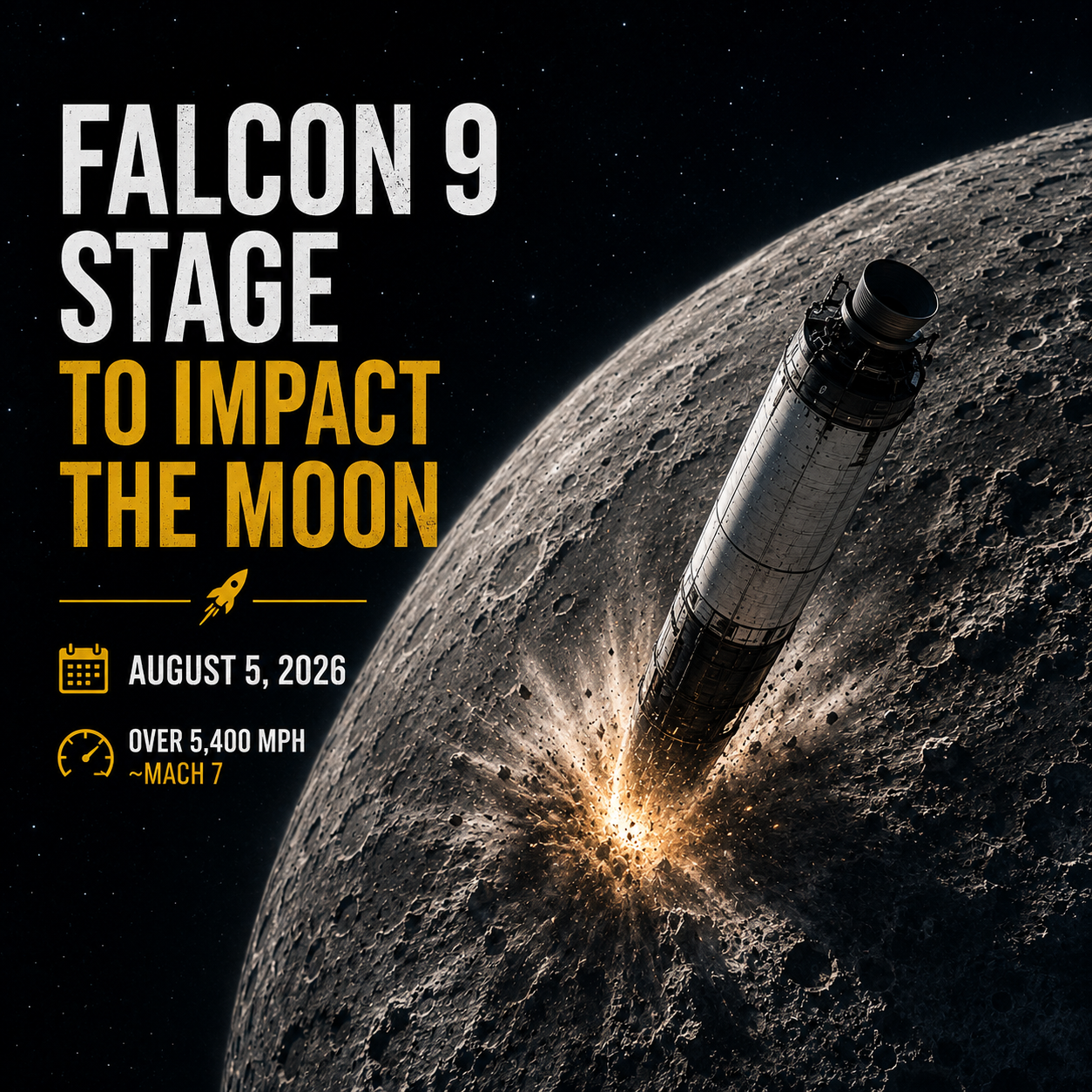
On August 5, 2026, a leftover piece of a SpaceX Falcon 9 rocket will complete a journey that was never part of its mission.
Traveling at more than 5,400 miles per hour, the discarded upper stage is expected to slam into the Moon, creating a brand-new impact crater and giving scientists a rare opportunity to study what happens when a known human-made object collides with the lunar surface.
While it may sound dramatic, there is no danger to Earth. The event will take place entirely on the Moon, roughly 238,900 miles away.
What Is Hitting the Moon?
The object isn’t an active spacecraft.
It’s the upper stage of a Falcon 9 rocket launched in January 2025 to send Firefly Aerospace’s Blue Ghost and ispace’s RESILIENCE lunar landers toward the Moon.
After completing its job, the stage had no fuel left to return to Earth or place itself into a stable orbit. Instead, it remained in an unstable Earth-Moon trajectory where the Moon’s gravity slowly altered its path over time.
Now, nearly a year and a half later, that journey is expected to end with an impact.
How Fast Is 5,400 Miles Per Hour?
The rocket stage is expected to strike the Moon at approximately:
- 5,400 mph
- 8,700 km/h
- Around Mach 7 (compared to Earth’s atmosphere)
Because the Moon has essentially no atmosphere, nothing will slow it down.
Unlike meteorites entering Earth’s atmosphere, the rocket stage won’t burn up. It will hit the lunar surface at full speed.
What Will Happen?
Scientists estimate the impact will produce a crater roughly:
- 90 feet (27 meters) wide
- 16 feet (5 meters) deep
The collision will blast lunar dust and rock high above the surface before the material settles back down in the Moon’s weak gravity.
The impact itself will last only an instant, but its effects could be studied for years.
Why This Matters
The Moon is constantly struck by natural meteoroids, but researchers almost never know:
- the exact size of the object,
- its composition,
- its speed,
- or the precise time of impact.
This event is different.
Scientists know almost everything about the object before it hits.
That allows them to compare computer models with the actual crater that forms, improving our understanding of:
- how lunar craters develop,
- how debris is ejected,
- how the Moon’s surface behaves during high-speed impacts,
- and the risks posed by future impacts near lunar infrastructure.
As humanity prepares to establish a permanent presence on the Moon, those answers become increasingly important.
Can We Watch It?
Unfortunately, probably not with the naked eye.
The impact is expected to occur near the Moon’s far-side limb from Earth’s perspective, making direct observation difficult.
Professional observatories and lunar orbiters, however, are expected to monitor the event closely.
NASA’s Lunar Reconnaissance Orbiter and South Korea’s Danuri spacecraft may later photograph the newly formed crater, allowing scientists to compare before-and-after images.
Is Space Junk Becoming a Problem?
This impact also highlights a growing issue.
As more governments and private companies send spacecraft beyond Earth, more hardware is being left in space than ever before.
Most missions are carefully planned, but older rocket stages sometimes remain in unstable orbits for years before eventually colliding with the Moon or drifting elsewhere through the Earth-Moon system.
Future missions are increasingly being designed with disposal plans that intentionally crash spacecraft in predetermined locations or move them into stable disposal orbits to reduce long-term hazards.
A Reminder of Humanity’s Growing Presence in Space
For thousands of years, every new crater on the Moon was created by nature.
Now, occasionally, they’re created by us.
The Falcon 9 upper stage wasn’t intended to become part of the Moon’s landscape, but on August 5 it will join the countless impact scars already covering our nearest celestial neighbor.
It’s a reminder that humanity’s reach into space continues to expand and with it comes the responsibility to understand not only where we go, but what we leave behind.

Websites, hosting, email & digital tools for growing brands.